Metatron gives Unitree G1 one frozen controller. The benchmarks are still simulated.
NVIDIA’s policy handles steering, reaching, recovery, teleoperated pickup and sitting through changing goal prompts. Its 83% reaching result and push tests are MuJoCo results, while hardware evidence remains qualitative.
Review basis: Analysis based on public information
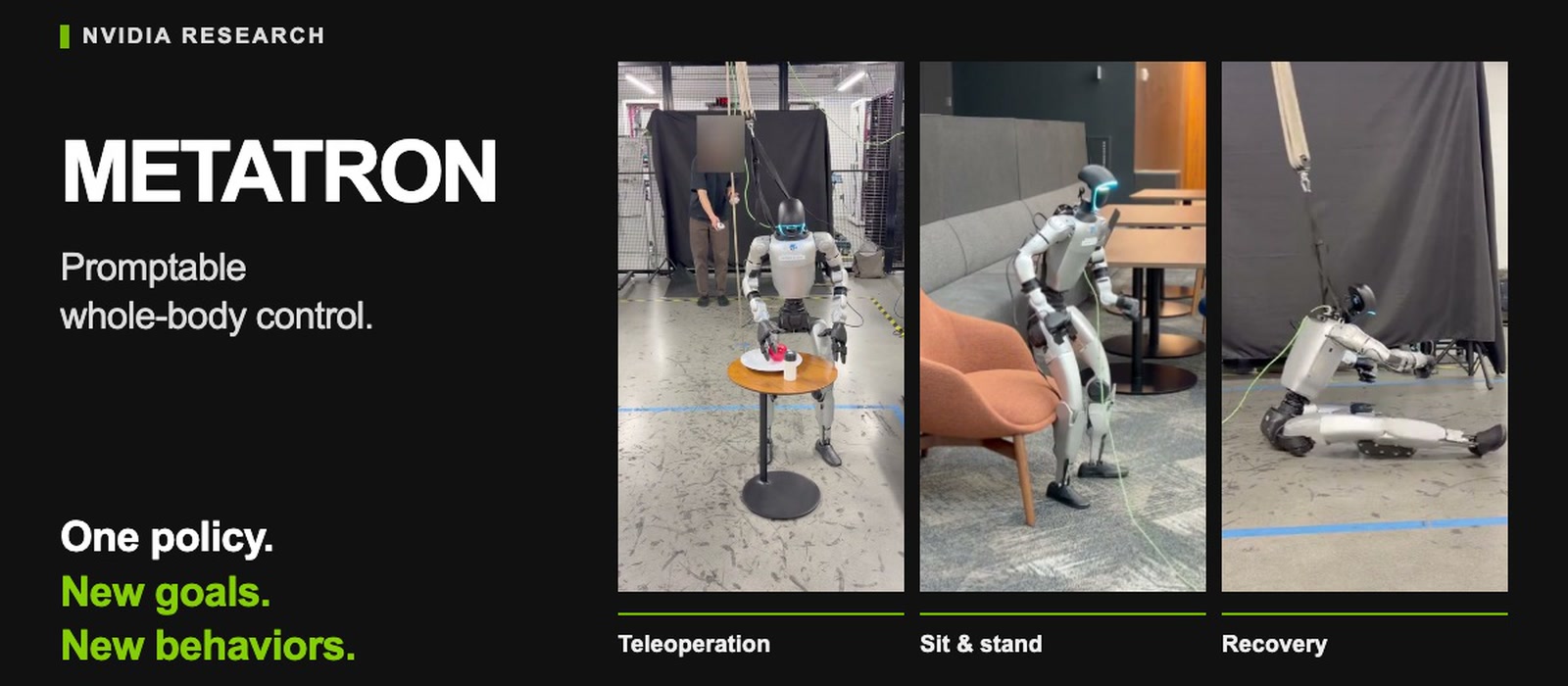
NVIDIA has released Metatron, a promptable whole-body control policy for the Unitree G1, together with a paper, source integration, downloadable weights and an interactive MuJoCo demonstration. The useful change is architectural: one frozen policy can respond to different combinations of body targets, velocity commands, timing, style examples and scene geometry without being retrained for every skill. [S1] [S2]
That does not make Metatron a natural-language robot brain. Its “prompts” are structured motion goals, not spoken instructions. A coding agent can help write and refine the program that generates those goals, but NVIDIA says the agent works offline. At run time, ordinary skill code supplies goals to the frozen controller, and a person decides whether to deploy it. [S2]
This distinction matters. Metatron is a reusable execution layer for coordinating the body. Perception, task selection, object localisation, long-horizon planning and safety remain outside it.
One policy, several ways to move
Metatron first learns from dense reference motions. The researchers then distil that capability into a generative policy trained to operate when only some goals are specified. A skill can ask for a travel velocity and heading, place a hand or foot at a future time, provide a style example, or describe nearby scene geometry. The policy fills in the rest of the coordinated whole-body motion. [S1]
On a physical G1, the same frozen checkpoint is shown in several modes. An Xbox controller supplies velocity and heading for steering. A PICO headset provides hand targets for teleoperated pickup. A sitting skill turns the robot toward a sofa, sits and stands. Recovery is triggered when torso height falls below a threshold, with demonstrations beginning from the robot’s back, front and other fallen poses. The project page says the real-robot clips play at normal speed. [S2]
These modes share policy weights, but they do not share the same level of autonomy. The grasping example is teleoperation. Steering comes from a human controller. For sitting, the paper says the G1 is positioned near the sofa and receives the seat bounding box as an input. It does not perceive the sofa, plan an approach and sit without external task context. Recovery is the closest of the demonstrations to a self-contained response, but the paper reports no repeated hardware success count.
The result is still meaningful. Switching goal interfaces without retraining the policy can reduce the engineering needed to move between locomotion, interaction and recovery. It does not show a robot independently deciding what to do in an unfamiliar room.
The headline numbers are simulation results
Metatron reaches 83% of a 54-target whole-body wrist-reaching grid, compared with 39% for ARDY plus SONIC, 28% for a GRU, inverse kinematics and SONIC pipeline, and 0% for GRU plus SONIC. The Metatron policy remains upright in all of those simulated trials. A target counts as reached when the wrist stays within 10 centimetres while the robot remains upright. [S1]
The push comparison is also conducted in MuJoCo. While the simulated G1 walks at one metre per second, a 100-millisecond force pulse is applied to its torso from eight directions. Metatron remains upright after eight seconds in 62% of trials at 600 newtons and 75% at both 800 and 1,000 newtons. The tested reference-tracking pipelines reach zero above 600 newtons. The authors warn that the non-monotonic sequence must not be read as stronger pushes being easier. [S1]
Those figures support the method against the selected simulation baselines. They are not real-G1 success rates, collision tests or safety certification. The hardware section is qualitative and explicitly calls for trials across more initial and operating conditions to quantify recovery reliability, gait stability, contact safety, actuation limits and failure modes.
Coding agents write skills, not joint commands
The project also demonstrates agent-assisted skill development. A person describes a task, a coding agent writes goal-setting code, simulation provides feedback, and the agent refines the goals while Metatron’s weights stay frozen. NVIDIA reports using GPT-6 Astra under human direction for simulated hurdle, bowling, tennis and football-kick skills. [S2]
This is closer to software development than to an LLM directly driving motors. The coding agent does not sit in the robot’s real-time control loop. Its output is a program that produces structured goals, while Metatron converts those goals into joint targets.
That separation can be an advantage. Real-time motor control has strict latency and safety requirements, while skill code can be inspected and tested before deployment. It also means the agent demos cannot be cited as evidence that a language model autonomously understands a physical scene or recovers from arbitrary errors.
What is actually open
NVIDIA publishes a native G1 checkpoint of about 459 MB and two approximately 403 MB ONNX exports for a single-robot browser pipeline and the six-robot G1 Racer. ProtoMotions supplies the integration and download instructions. The source is Apache-2.0; the model artifacts use the NVIDIA Open Model License. [S3] [S4]
The release is useful but not a complete training reproduction package. NVIDIA does not redistribute the training motion clips, robot meshes or every application asset in the model repository. The two browser exports use different interfaces and are not interchangeable. Their reported numerical parity checks verify export consistency, not task success or physical-robot performance. [S3]
The model card also says Metatron is not a collision-avoidance system or safety controller. Hardware use requires independent validation, appropriate joint and torque limits, supervised testing and an emergency stop. Recovery, balance and tracking can fail outside the evaluated states, terrain and command distribution. [S3]
What Australian teams should take from it
For an Australian lab with a G1, Metatron offers a more concrete starting point than a demonstration video alone: inspectable code, downloadable weights, a browser simulation and a documented deployment path. It may let researchers spend more time on perception, task logic and evaluation instead of training separate whole-body controllers for every behaviour.
The practical test is whether one frozen policy remains reliable when goals come from real perception, people move through the workspace and the environment differs from the lab. That evidence is not in this release. Neither are repeated hardware trial counts, independent reproduction or deployment economics.
Metatron therefore advances the tooling available for Unitree G1 research. Its public evidence supports a reusable control interface and promising simulated robustness. It does not yet support claims of general autonomy, dependable recovery or safe workplace deployment.
This analysis does not change PHASE SHIFT.
Sources & analysis
Primary source
NVIDIA Research: Metatron project page and real-robot demonstrations; checked 2 November 2026
Primary source
NVIDIA: Metatron v1 model card and downloadable G1 artifacts; checked 2 November 2026
Primary source
NVlabs ProtoMotions: pretrained Metatron G1 model documentation; checked 2 November 2026
This is an independent, unofficial publication and is not affiliated with Unitree Robotics.
Related reading
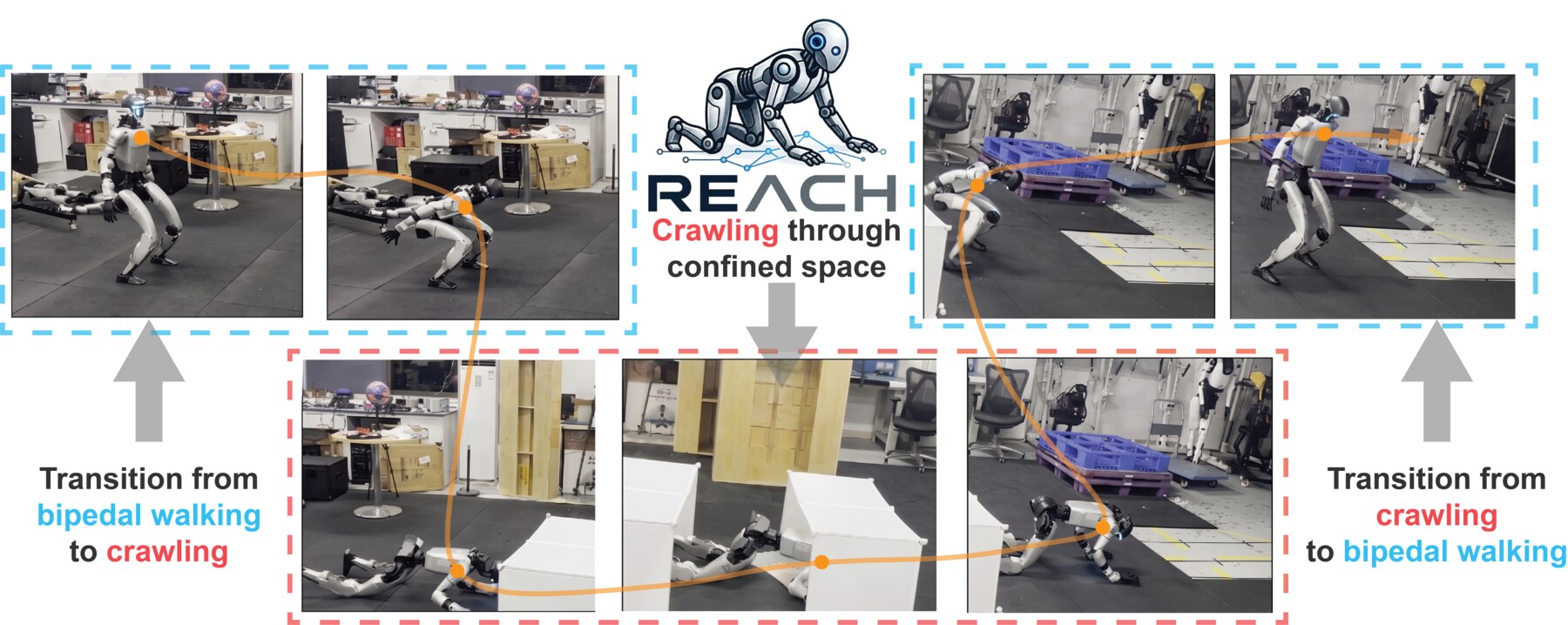
REACH gets Unitree G1 under a 40 cm clearance. The reliability result is narrower.
The system combines LiDAR planning, variable-height walking and crawling. Its 48/50 real-robot transition result is measured; the full confined-space runs are still demonstrations.
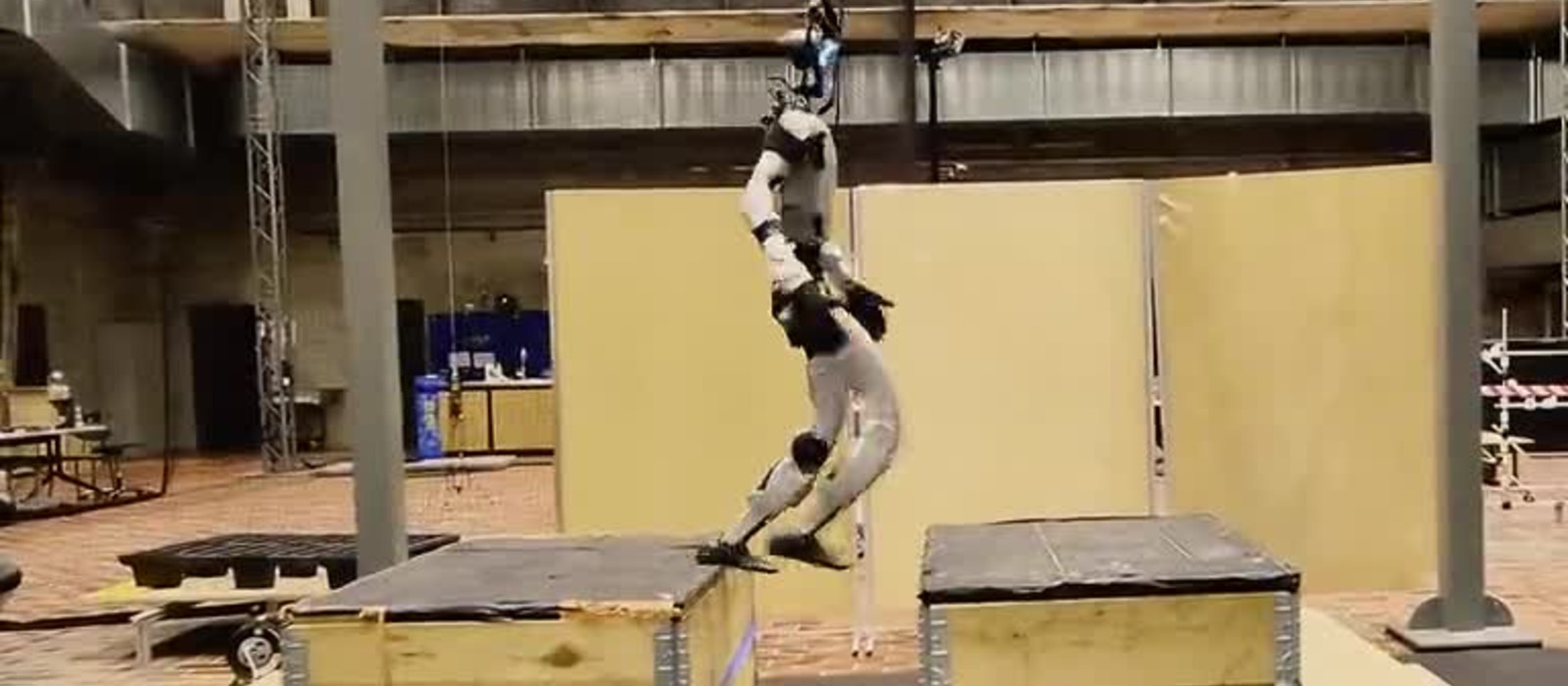
Watch Your Step cuts what Unitree G1 needs to see before it steps
A foothold predictor reduces the terrain input from 693 heights to 102 values and reaches the training curriculum roughly three times sooner. Real G1 videos show transfer, not measured reliability.
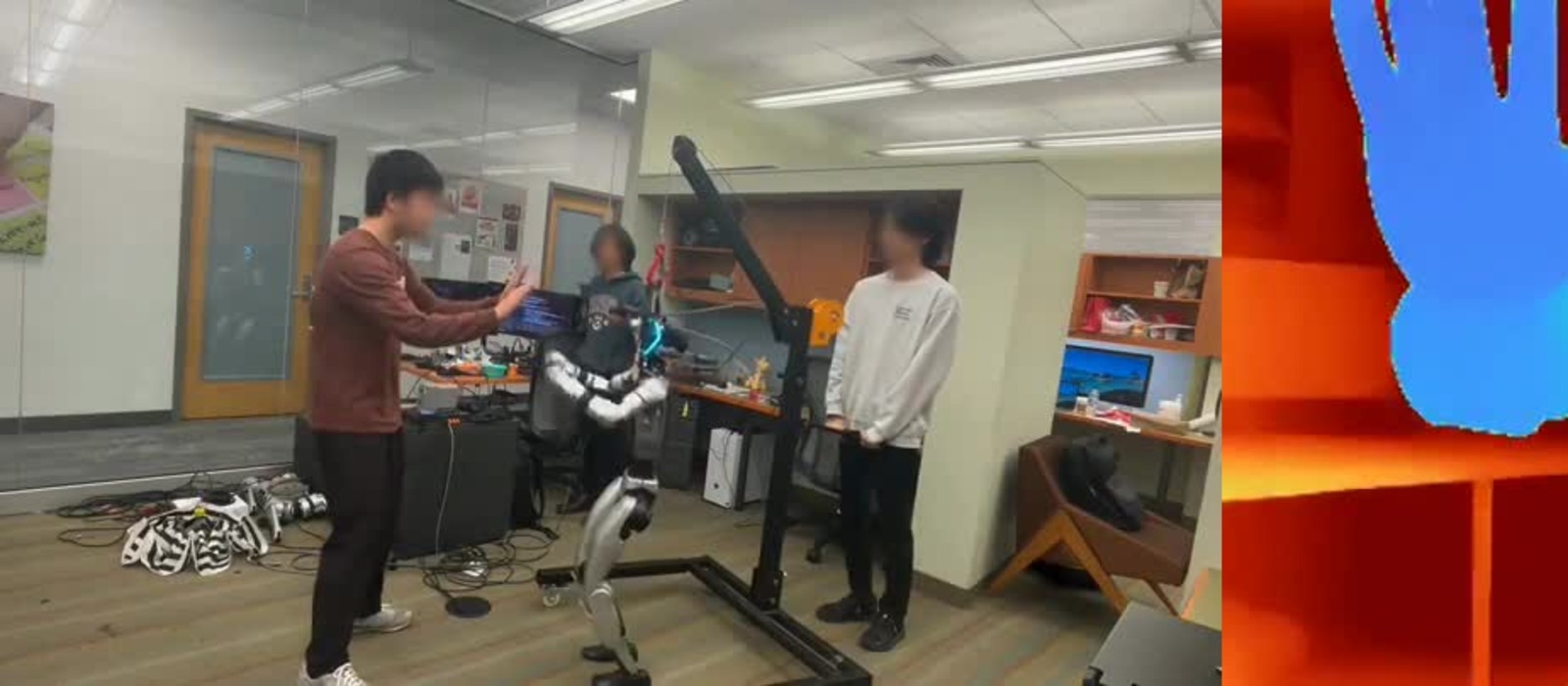
REACT lets a Unitree G1 handle close contact from its own camera
The research system completed 31 of 50 staged real-robot trials with no teleoperation or external tracking. Its five short interactions are not evidence of safe care or workplace deployment.
Reader discussion
No comments yet. Add the first thoughtful contribution.
Join the discussion