Watch Your Step cuts what Unitree G1 needs to see before it steps
A foothold predictor reduces the terrain input from 693 heights to 102 values and reaches the training curriculum roughly three times sooner. Real G1 videos show transfer, not measured reliability.
Review basis: Analysis based on public information
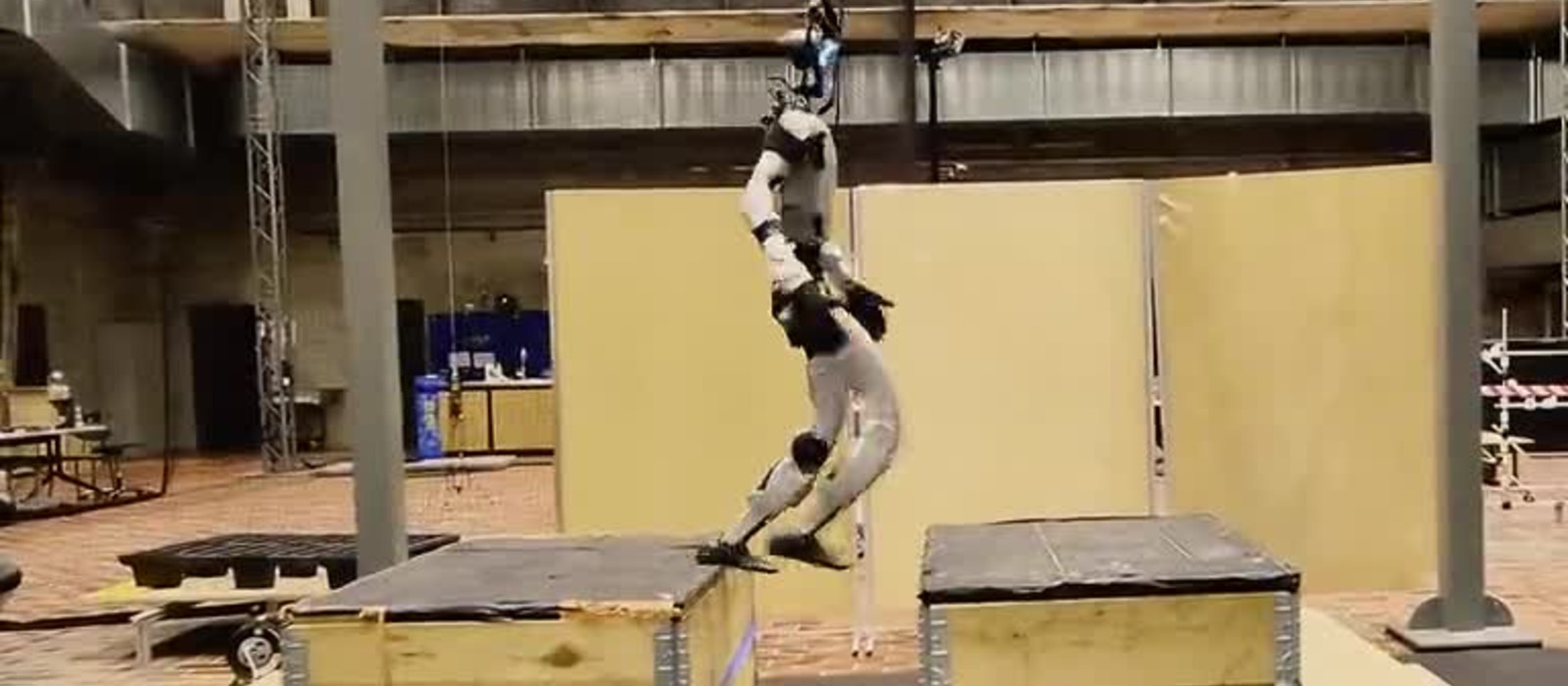
A humanoid does not need to study every patch of ground equally. It needs good information about the places where its feet are about to land.
That is the premise of Watch Your Step, a new ETH Zürich locomotion system for the Unitree G1. Instead of feeding a reinforcement-learning policy a large elevation map around the robot, the system predicts the next two footholds and samples two small height-map patches around them.
The result is a useful efficiency claim backed by controlled simulation comparisons, plus a real G1 demonstration that shows the policy can leave the simulator. It is not yet a reliability claim for hardware in the field.
What is actually new
The foothold prediction model takes the robot’s proprioceptive state and an operator-supplied velocity command, then predicts two planar landing positions. The locomotion policy receives 7 by 7 terrain patches centred on those predicted footholds, along with the foothold coordinates.
That reduces the terrain input from 693 height samples in the paper’s full-map baseline to 98 local height samples plus four coordinates: 102 values in total. The predictor and walking policy are trained together, with the predictor periodically refitted using data from the policy as it improves.
This is a different use of prediction from commanding exact footsteps. The predicted footholds decide where the robot looks; the policy still chooses the motion. That separation matters because the system can focus perception without requiring a human or planner to specify every foot placement.
The authors trained the 29-degree-of-freedom G1 model in Isaac Lab and have released the training and evaluation code, a pretrained policy and the foothold model under the MIT licence. The repository states Isaac Sim 5.1, Isaac Lab 2.3.0 and rsl-rl-lib 3.3.0 as dependencies.
The strongest numbers are simulation numbers
Across five training seeds, the foothold-prediction method reached the paper’s terrain-curriculum level 5 after 7,500 policy iterations on average. The full elevation-map baseline took 26,100 iterations, the convolutional baseline 25,200 and the attention-based comparison 20,000.
That supports a narrow but meaningful conclusion: directing perception around anticipated contacts made this training curriculum roughly 2.7 to 3.5 times faster to reach the stated threshold.
It does not mean the robot walks 3.5 times faster, uses 3.5 times less power or succeeds 3.5 times more often in the real world.
The final simulation results are also more mixed than the training-speed headline. Over 1,000 episodes per terrain type, the foothold method averaged 84.6 per cent success on training terrains and 83.1 per cent on five out-of-distribution terrains. Its out-of-distribution fall rate was 5.2 per cent. The attention baseline slightly exceeded its out-of-distribution success at 83.6 per cent, while the full-map method recorded a lower fall rate on the training set.
The paper’s sparse-gap and sparse-corridor tests are encouraging: the method reports 77.7 per cent success on sparse gaps and 74.2 per cent in the sparse-corridor category. Those remain simulator results produced by the authors’ evaluation code. They should not be transferred to the physical G1.
What the real G1 does show
The project videos show a Unitree G1 crossing irregular blocks, climbing and descending stairs, stepping over gaps and negotiating narrow passages. The paper reports a 0.55-metre gap, a 0.6-metre drop and an outdoor staircase of 18 steps, including obstacles outside the training distribution.
That is useful evidence of zero-shot transfer: the authors say the policy was deployed on the robot without further training, and the visible behaviours match the paper’s core claim that anticipated footholds can guide local terrain sensing on hardware.
There are important limits to that evidence. The paper does not publish physical trial counts, hardware success rates, fall rates or comparisons against the baseline policies on the same real-world courses. The clips are selected researcher demonstrations, not independent tests. An overhead safety tether is visible in the indoor gap footage selected for this article.
The system also receives a velocity command and an elevation map. It is not choosing a destination, planning a route through a building or deciding how to move around people. This is perceptive locomotion under commanded motion, not autonomous navigation.
The blind spot is part of the design
Looking only near predicted footholds saves input and accelerates training, but it deliberately discards terrain elsewhere.
The authors identify side obstacles as a particular limitation. An object beside the intended foot path may be detected late or not at all. Their experiments also show the full-map methods retaining an advantage on stepped terrain, where broader context can help.
The useful prediction horizon is short. Error grows for the second predicted foothold and is substantially larger for a third, which is why the final policy uses two. The reported error for that third foothold is about 22 centimetres—roughly the length of the G1 foot.
These are not small editorial caveats. They describe the trade-off the method makes: faster learning and compact inputs in exchange for less environmental context. A deployable system may need a second perception or planning layer for body-height obstacles, people, moving objects and hazards that are not directly under the next two steps.
Why it matters for Australian labs
For Australian robotics teams, the immediate value is reproducibility rather than a new G1 product feature.
The public repository provides the training structure, evaluation scripts and pretrained models, which gives universities and integrators a more concrete starting point than a demonstration video alone. It also makes the paper’s distinction between policy learning and foothold prediction inspectable.
A sensible local evaluation would measure repeated hardware trials on the surfaces that matter to the intended use: ramps, grates, loose material, outdoor glare, wet ground and transitions between floor types. It should record intervention, near-fall and recovery rates, not just completed runs. Tests should also separate failures in elevation mapping from failures in foothold prediction or control.
The method may reduce the learning burden for terrain-aware walking. It does not remove the need for external perception, task planning, safe operating boundaries or a hardware validation programme.
Watch Your Step is therefore notable for doing less, deliberately. Its strongest contribution is evidence that a humanoid locomotion policy can learn faster by looking where its own feet are likely to go. The real G1 demonstrations make that idea credible enough to reproduce. They do not yet establish how often the robot will succeed when the course, sensors and consequences are no longer curated by the research team.
PHASE reviewed the paper, official project page and public code repository on 26 October 2026. The paper is an arXiv preprint under review. This is analysis of public information, not a hands-on test.
Sources & analysis
Primary source
Watch Your Step: Anticipated Perception for Humanoid Locomotion arXiv · Published 2026-10-21 · Retrieved 25 October 2026
Primary source
Watch Your Step project page ETH Zürich Robotic Systems Laboratory · Published 2026-10-21 · Retrieved 25 October 2026
Primary source
Foothold prediction model: training and evaluation code ETH Zürich Robotic Systems Laboratory · Published 2026-10-22 · Retrieved 25 October 2026
This is an independent, unofficial publication and is not affiliated with Unitree Robotics.
Related reading
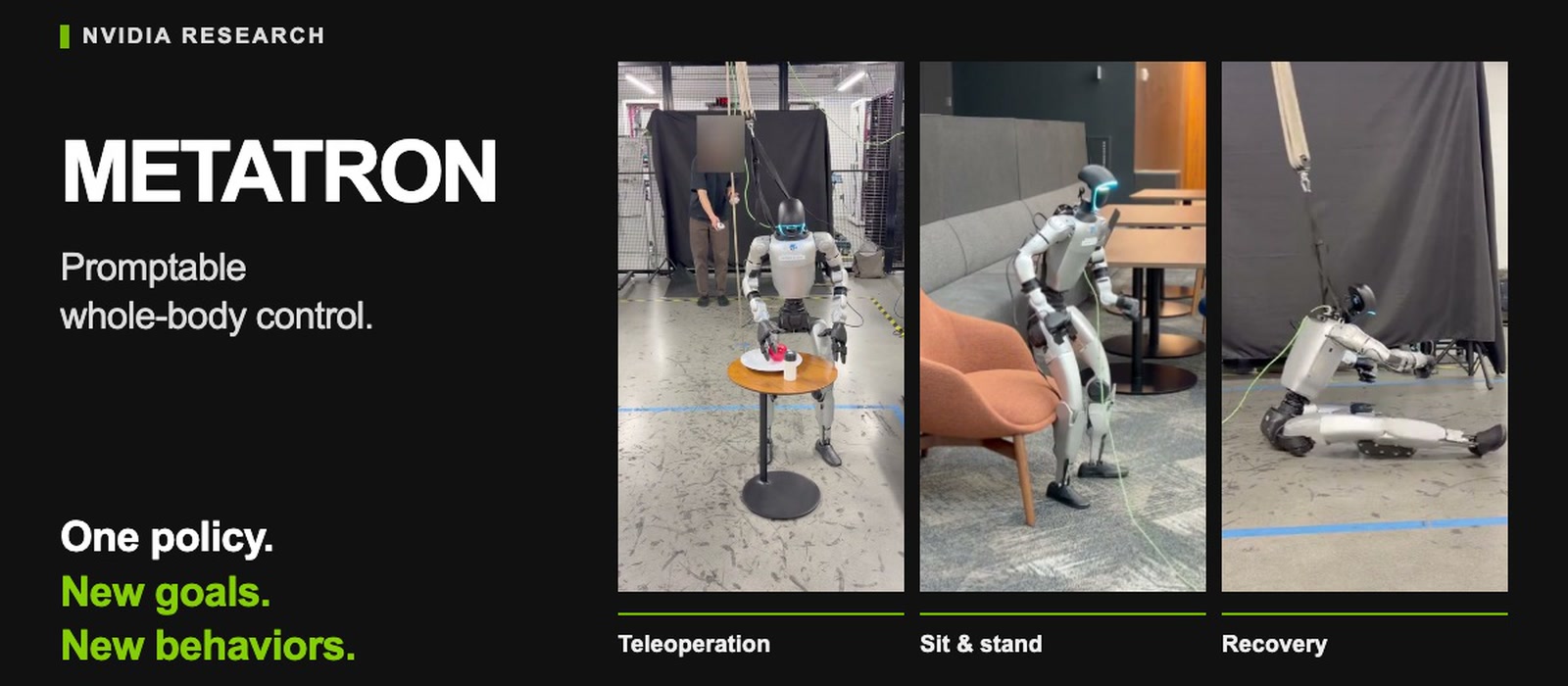
Metatron gives Unitree G1 one frozen controller. The benchmarks are still simulated.
NVIDIA’s policy handles steering, reaching, recovery, teleoperated pickup and sitting through changing goal prompts. Its 83% reaching result and push tests are MuJoCo results, while hardware evidence remains qualitative.
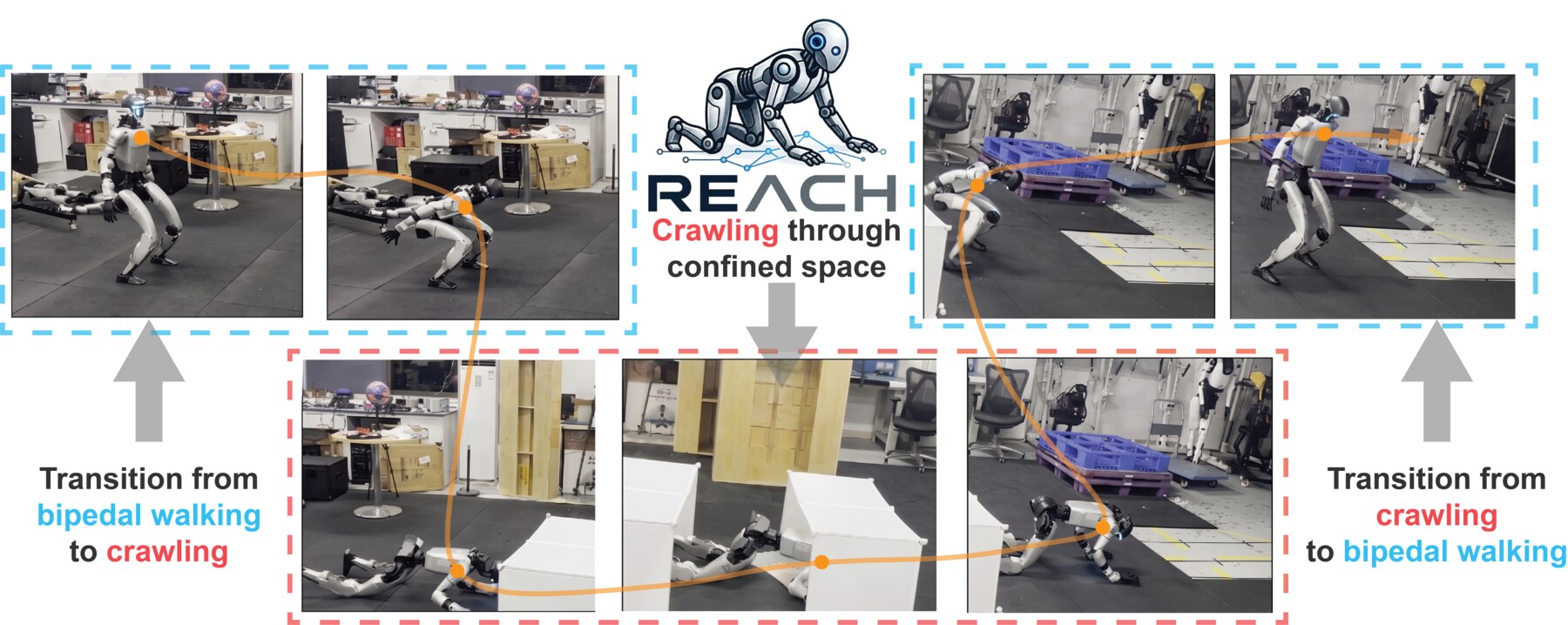
REACH gets Unitree G1 under a 40 cm clearance. The reliability result is narrower.
The system combines LiDAR planning, variable-height walking and crawling. Its 48/50 real-robot transition result is measured; the full confined-space runs are still demonstrations.
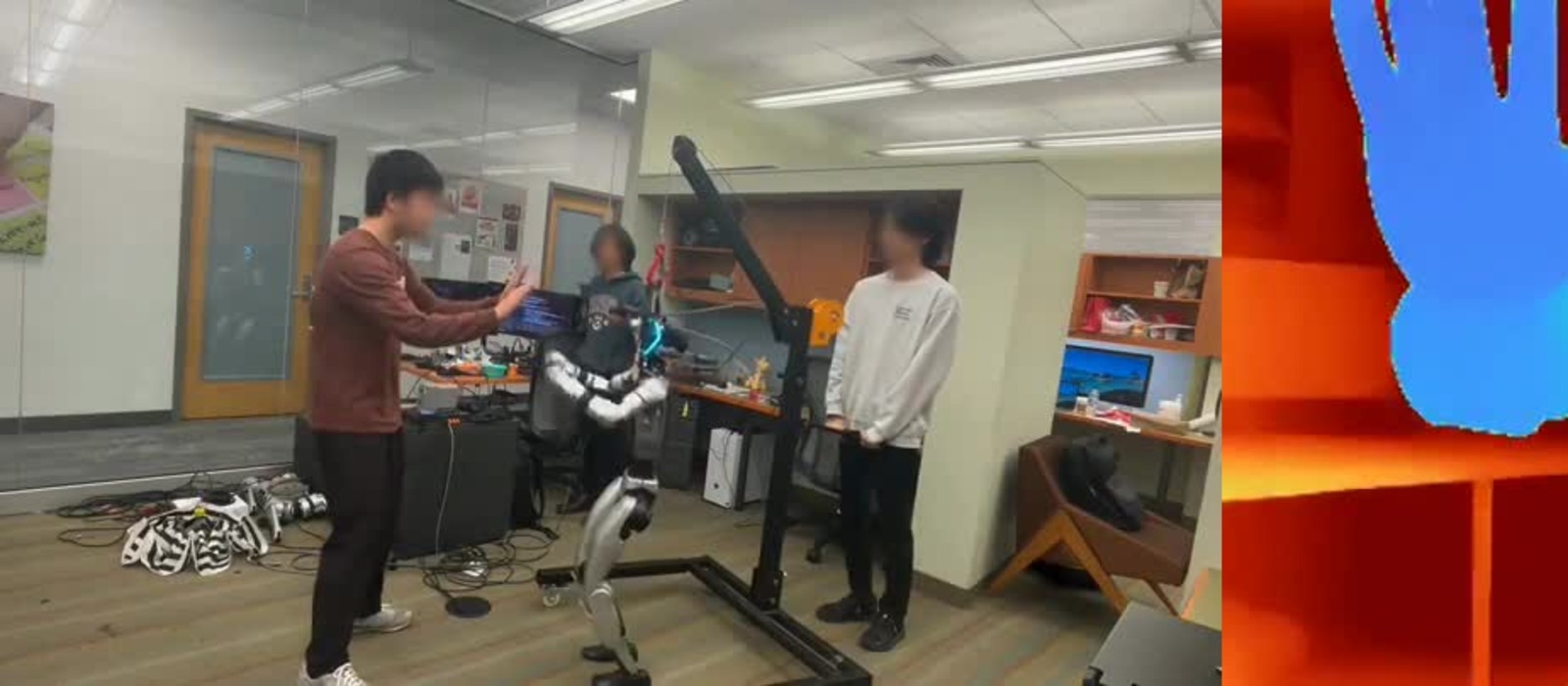
REACT lets a Unitree G1 handle close contact from its own camera
The research system completed 31 of 50 staged real-robot trials with no teleoperation or external tracking. Its five short interactions are not evidence of safe care or workplace deployment.
Reader discussion
No comments yet. Add the first thoughtful contribution.
Join the discussion