Motion tokens let Unitree G1 switch from fighting to dancing. The plan is still offline.
A TU Darmstadt system runs generated dance, fight and walk sequences on a physical G1 through compact motion tokens. The 35-second transition is real hardware evidence, but not online replanning or a task-reliability benchmark.
Review basis: Analysis based on public information

A TU Darmstadt team has shown a Unitree G1 executing generated whole-body motions through a compact stream of discrete motion tokens. The paper, submitted on 27 October 2026 and listed for Humanoids 2026, reports separate 16.8-second dance, fight and walk sequences plus a 35.2-second fight-to-dance transition on physical hardware. [S1] [S2]
The useful change is the interface between motion generation and control. Instead of sending a velocity command or a full pose at every step, the system groups 0.8 seconds of intended motion into a small token chunk. A high-level transformer arranges those chunks; one reinforcement-learning policy turns them into movement on the robot.
This is not yet an online language-to-action system. The motion banks used on the G1 were generated offline, and the deployed robot followed fixed token schedules. The paper reports completed sequences, not repeated task trials, success rates or independent reproduction.
A motion vocabulary for the whole body
The system has three stages. First, a stochastic tokenizer called DAPS compresses retargeted G1 motion into a discrete representation. Second, a 12-layer transformer named TrajectoryGPT predicts the next motion chunk from a behaviour condition and recent token history. Third, a PPO tracking policy receives the current chunk and two future chunks, then produces joint targets for the 29-degree-of-freedom G1. [S1]
Each source window covers 24 frames at 30 Hz, or 0.8 seconds. It becomes 16 tokens drawn from a vocabulary of 1,024 entries: 160 bits per chunk. The tracking policy sees three chunks, so 480 bits describe 2.4 seconds of intended motion.
That look-ahead is the central control idea. A robot preparing to change from fighting to dancing needs information about what is coming next, not just the command for the current instant. During the 1.6-second transition in the hardware demonstration, two wildcard chunks remove the exact reference while future dance tokens remain visible. The low-level policy is free to connect the surrounding motions while stability penalties stay active. [S1]
What the physical G1 actually did
The paper says the G1 remained upright while completing generated dance, fight and walk motions of 16.8 seconds each. A separate policy completed the full 35.2-second fight-to-dance sequence, including the wildcard bridge, at a 50 Hz control rate. Figure 7 shows the robot moving through that transition on hardware. [S1]
This supports two narrower claims. Generated token schedules can be transferred from simulation to a real G1, and one tracking policy can bridge at least one demonstrated pair of behaviours without receiving a prescribed reference during the transition interval.
It does not establish general skill switching. The paper does not give the number of hardware attempts, per-motion failure rates, falls, recovery behaviour or a comparison against another controller on the robot. The authors identify a scaling study across more motions and harder transitions as a next step.
The motions are also not tasks in the operational sense. Dancing, fighting and walking here are movement categories. There is no object goal, perception loop, human interaction outcome or workplace success criterion.
The quantitative win is a tokenizer result
At the same 160-bit bottleneck, DAPS reconstructs validation motion more accurately than two common alternatives. On BONES-SEED, joint-position error is 7.1 plus or minus 0.3, compared with 9.0 plus or minus 0.4 for finite scalar quantisation and 11.5 plus or minus 1.7 for VQ-VAE. On LAFAN1, the corresponding values are 14.4 plus or minus 1.0, 19.0 plus or minus 1.5 and 28.3 plus or minus 3.0, all in units of 0.001. Each comparison uses five seeds. [S1]
Those numbers measure motion reconstruction in the representation layer. They are not physical G1 success rates or tracking accuracy. The paper separately plots measured hardware joints against source kinematics, but it does not reduce that comparison to a repeated-trial reliability figure.
The training data includes LAFAN1 and BONES-SEED. The latter publishes 142,220 annotated motions, about 288 hours at 120 Hz, including trajectories retargeted to a MuJoCo-compatible Unitree G1 format. Access to the files requires accepting the dataset licence. [S3]
Preplanned is not replanned
The paper is unusually clear about the runtime boundary. The reported reference banks are generated offline. Neither TrajectoryGPT nor the motion decoder runs in the 50 Hz deployment loop. The robot consumes the resulting token schedule through the tracking policy. [S1]
TrajectoryGPT is not conditioned on the robot’s measured state, so the high-level sequence is preplanned rather than replanned. The low-level policy reacts to dynamics while tracking, but the generator does not observe a deviation and produce a new plan around it.
The tokens also describe motion style without fixing a global path. Planar root position is not explicitly tracked. Navigation would require a goal or path-conditioned context, while perception, obstacle avoidance and task planning would still need separate systems.
This distinction keeps the result useful. A compact motion vocabulary could give future planners a cleaner way to request expressive whole-body behaviour. It does not show that a G1 can take a live text instruction, interpret a scene and adapt the sequence when the world changes.
What Australian teams should take from it
For Australian labs working with G1, the paper suggests a practical research direction: separate high-level motion composition from a reusable low-level tracking policy, and give the tracker enough future intent to prepare for transitions. The compact interface may also reduce the data passed between a planner and controller.
The evidence is not yet a deployment package. The public sources checked by PHASE provide the paper, conference record and source dataset, but not a linked release of the trained tokenizer, TrajectoryGPT weights or G1 tracking policy. Reproduction would require rebuilding the three-stage pipeline and validating it under local hardware, safety and emergency-stop procedures.
The next convincing result would combine online state-conditioned generation with held-out motion schedules, repeated hardware trials and task-level evaluation. Until then, the work is best read as a promising control interface and a real sim-to-real demonstration, not a general-purpose robot skill system.
This analysis does not change PHASE SHIFT.
Sources & analysis
Primary source
TU Darmstadt Intelligent Autonomous Systems: Humanoids 2026 publication record; checked 3 November 2026
Primary source
BONES-SEED dataset card: motion corpus and Unitree G1 format; checked 3 November 2026
This is an independent, unofficial publication and is not affiliated with Unitree Robotics.
Related reading
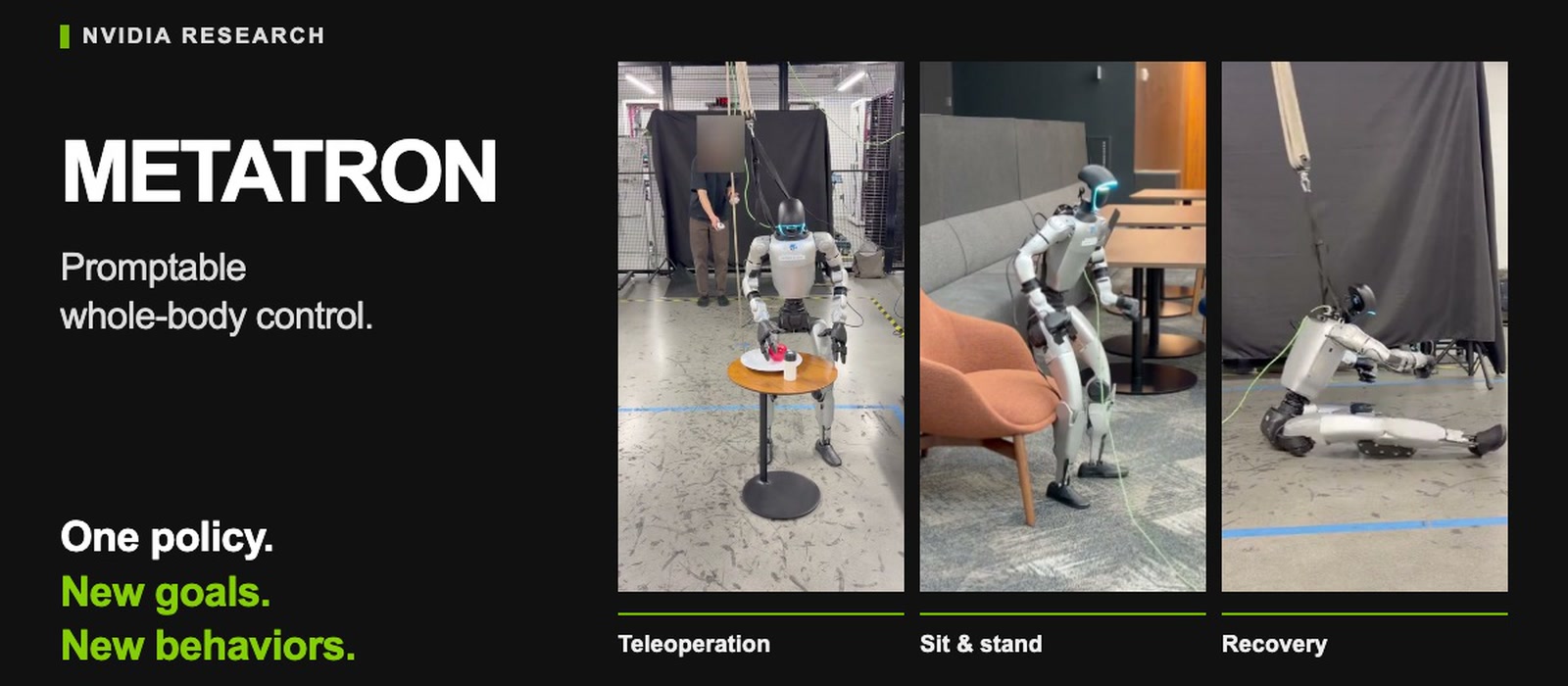
Metatron gives Unitree G1 one frozen controller. The benchmarks are still simulated.
NVIDIA’s policy handles steering, reaching, recovery, teleoperated pickup and sitting through changing goal prompts. Its 83% reaching result and push tests are MuJoCo results, while hardware evidence remains qualitative.
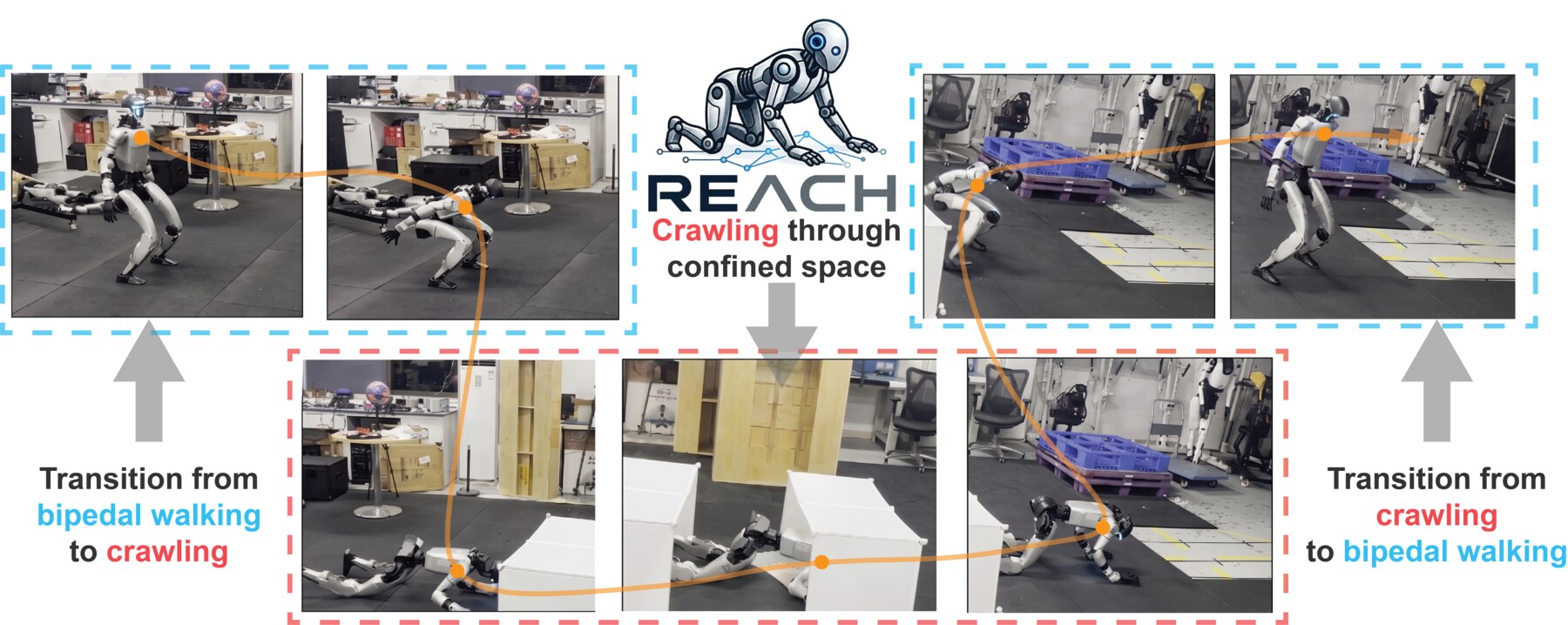
REACH gets Unitree G1 under a 40 cm clearance. The reliability result is narrower.
The system combines LiDAR planning, variable-height walking and crawling. Its 48/50 real-robot transition result is measured; the full confined-space runs are still demonstrations.
Watch Your Step cuts what Unitree G1 needs to see before it steps
A foothold predictor reduces the terrain input from 693 heights to 102 values and reaches the training curriculum roughly three times sooner. Real G1 videos show transfer, not measured reliability.
Reader discussion
No comments yet. Add the first thoughtful contribution.
Join the discussion