SuperMimic cuts the compute needed to train a Unitree G1 motion tracker
A differentiable world model beats a 128-GPU motion-tracking baseline’s return after three hours on one H100. The headline result is simulated; the physical G1 evidence remains a demonstration.
Review basis: Analysis based on public information

Whole-body motion tracking is one of the fastest ways to make a humanoid appear broadly capable — and one of the most compute-hungry to train at scale. SuperMimic, a new UC Berkeley system, changes that economics more convincingly than it changes what the robot can do.
The authors report that a SuperMimic policy trained for three hours on one NVIDIA H100 exceeded the normalized return of the released SONIC checkpoint, which was trained for seven days on 128 NVIDIA L40 GPUs. That is a striking training-efficiency result. It is not evidence that a Unitree G1 learned a general task in three hours, and it is not a measured physical-robot success rate.
One learned world model replaces most simulator rollouts
Conventional large-scale motion trackers repeatedly roll out a policy in a rigid-body simulator and improve it with model-free reinforcement learning. SuperMimic still collects transitions from a standard simulator, but it uses those transitions to fit one differentiable world model shared across the motion library.
The policy then improves by backpropagating through short imagined rollouts in that learned model. The simulator itself does not need to be differentiable. The world model and the policy are updated together, and a critic estimates the return beyond each short rollout.
That distinction explains why the compute claim is plausible. The authors report that the learned model generates rollouts more than ten times faster than MuJoCo Warp at their practical batch sizes. More importantly, their first-order policy updates reach the best return of a PPO-on-world-model baseline with about 64 times fewer imagined steps. The gain is therefore not only a faster simulator surrogate; it also comes from using a more direct gradient.
The headline comparison is large, but not perfectly matched
SONIC’s reported training budget was 128 L40 GPUs for 168 hours, or roughly 21,000 GPU-hours. SuperMimic exceeded the released SONIC checkpoint’s normalized return after three hours on one H100. The authors describe this conservatively as more than 1,000 times fewer GPU-hours and more than 50 times less wall-clock time; the raw ratios are about 7,200 and 56 respectively.
This is not a controlled hardware shoot-out. The GPU generations differ, and utilisation for either run is not reported. The training data also differ: SONIC used 611 hours of motion, while SuperMimic used the public 264.56-hour BONES-SEED subset. The paper argues that neither the 2.3-fold data difference nor the chips’ peak-throughput difference can explain a compute gap of this size. That is reasonable, but independent reproduction would be more persuasive than peak-spec arithmetic.
The fairest conclusion is that the method has removed a major research cost within this benchmark. It does not prove that every humanoid-control workload will shrink by the same factor.
“None failed” measures training coverage, not generalisation
The project page gives another memorable comparison. Across 129,514 motions, the released SONIC checkpoint triggered the benchmark’s failure condition on 179. SuperMimic failed 25 after three hours on one H100 and none after 9.8 hours on two H100s.
All 129,514 motions come from the filtered training set used by both methods. Each is evaluated once from its first frame in deterministic simulation, with no observation noise or domain randomisation. A failure means the rollout crossed SuperMimic’s training termination threshold.
Those details matter. The result measures how completely one policy covers its training library. It does not measure performance on unseen motions, noisy sensors, unfamiliar terrain or a physical G1. “No failed motions” is not the same claim as a 100% real-world success rate.
The G1 evidence is a demonstration, not a reliability study
The paper does include physical transfer. One policy is shown running on a Unitree G1 without per-motion tuning, covering a skipping jump, a side roll, a 90-degree flip and an in-place 360-degree flip. That is credible evidence that the learned controller can cross the simulation-to-reality gap for several difficult motions.
The paper does not report a physical trial count, success rate or failure distribution. The public evidence is a set of researcher-produced clips, not an independently reproduced reliability study. It should therefore be read as a real-robot demonstration rather than a deployment metric.
It is also motion tracking, not general autonomy. The policy receives a reference motion and tries to reproduce it from proprioceptive observations. It does not choose a useful task, understand a worksite, manipulate an object or plan around people. The paper’s velocity-command interface is preliminary, and its evaluation is in simulation.
What remains outside the result
SuperMimic’s world model learns only from simulator transitions. The training setup uses flat ground and does not cover terrain or object interaction; the authors list both as future work. The project’s physical clips show a capable G1, but they do not establish robustness to surface variation, wear, payload, lighting, bystanders or repeated daily operation.
The comparison also depends on a released SONIC checkpoint rather than a new SONIC run on matched hardware and data. That is understandable — reproducing a 21,000-GPU-hour baseline would defeat much of the point — but it leaves room for implementation and tuning differences.
For Australian robotics laboratories, the important change is accessibility. If a large motion tracker can genuinely be trained and iterated on with one or two datacentre GPUs rather than a 128-GPU cluster, more teams can test control ideas, rerun ablations and scrutinise failures. That lowers the cost of research. It does not lower the burden of physical safety validation.
SuperMimic is best understood as a strong systems result: one learned dynamics model amortises a large motion library into a single tracker with dramatically less compute, then transfers selected motions to a real G1. The next questions are whether other teams can reproduce the training curve, whether unseen motions and environments hold up, and whether physical trials show repeatable reliability rather than memorable clips.
PHASE reviewed the paper, its submission history and the official project page on 22 October 2026. This is an analysis of public research, not a hands-on test.
Sources & analysis
Primary source
SuperMimic: Scaling Humanoid Whole-Body Control with One Differentiable World Model arXiv · Published 2026-10-20 · Retrieved 21 October 2026
Primary source
SuperMimic arXiv record and submission history arXiv · Published 2026-10-20 · Retrieved 21 October 2026
Primary source
SuperMimic official project page SuperMimic research team · Published 2026-10-20 · Retrieved 21 October 2026
This is an independent, unofficial publication and is not affiliated with Unitree Robotics.
Related reading
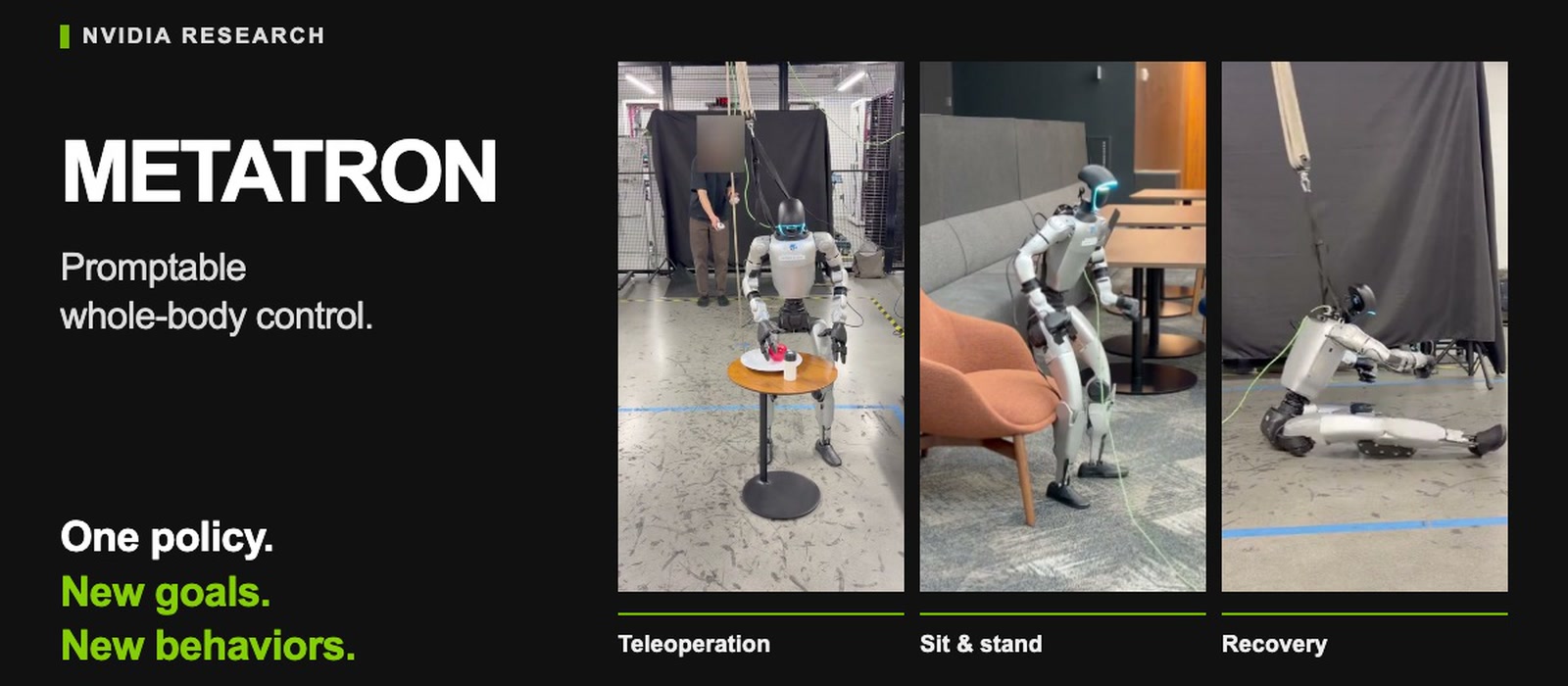
Metatron gives Unitree G1 one frozen controller. The benchmarks are still simulated.
NVIDIA’s policy handles steering, reaching, recovery, teleoperated pickup and sitting through changing goal prompts. Its 83% reaching result and push tests are MuJoCo results, while hardware evidence remains qualitative.
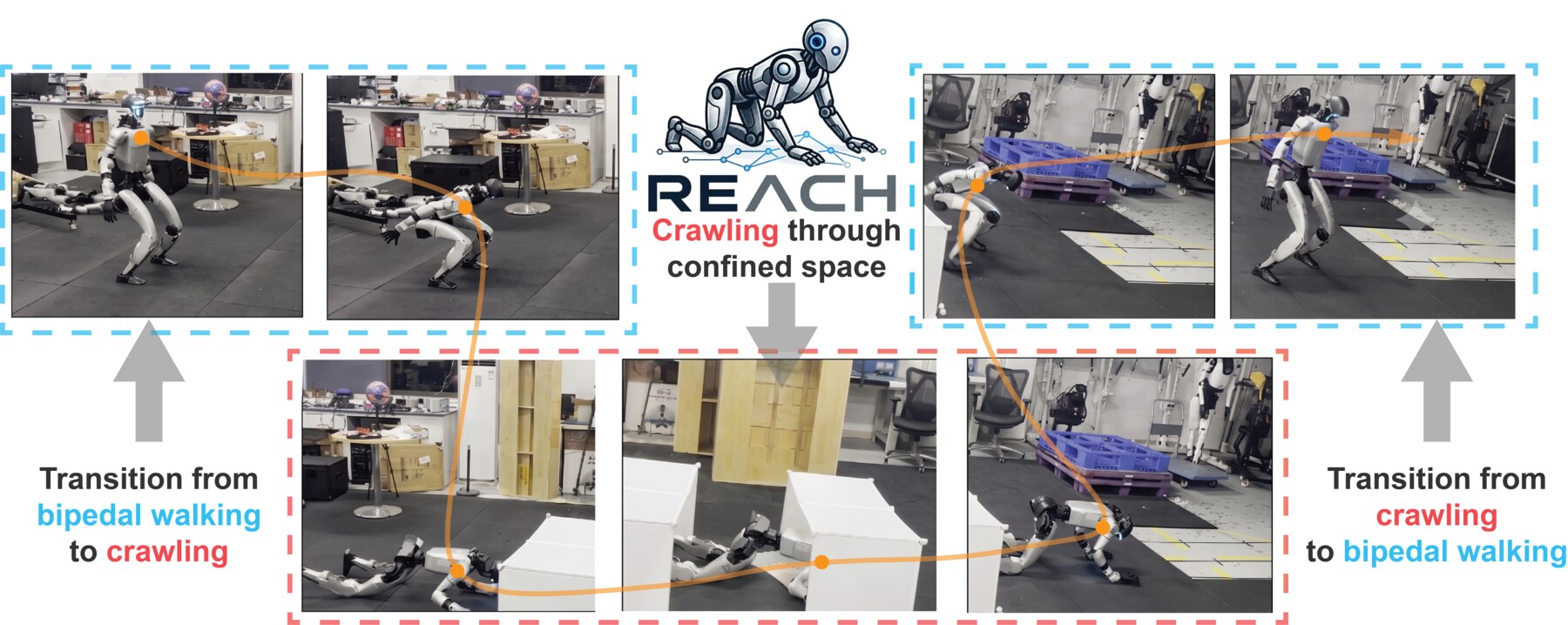
REACH gets Unitree G1 under a 40 cm clearance. The reliability result is narrower.
The system combines LiDAR planning, variable-height walking and crawling. Its 48/50 real-robot transition result is measured; the full confined-space runs are still demonstrations.
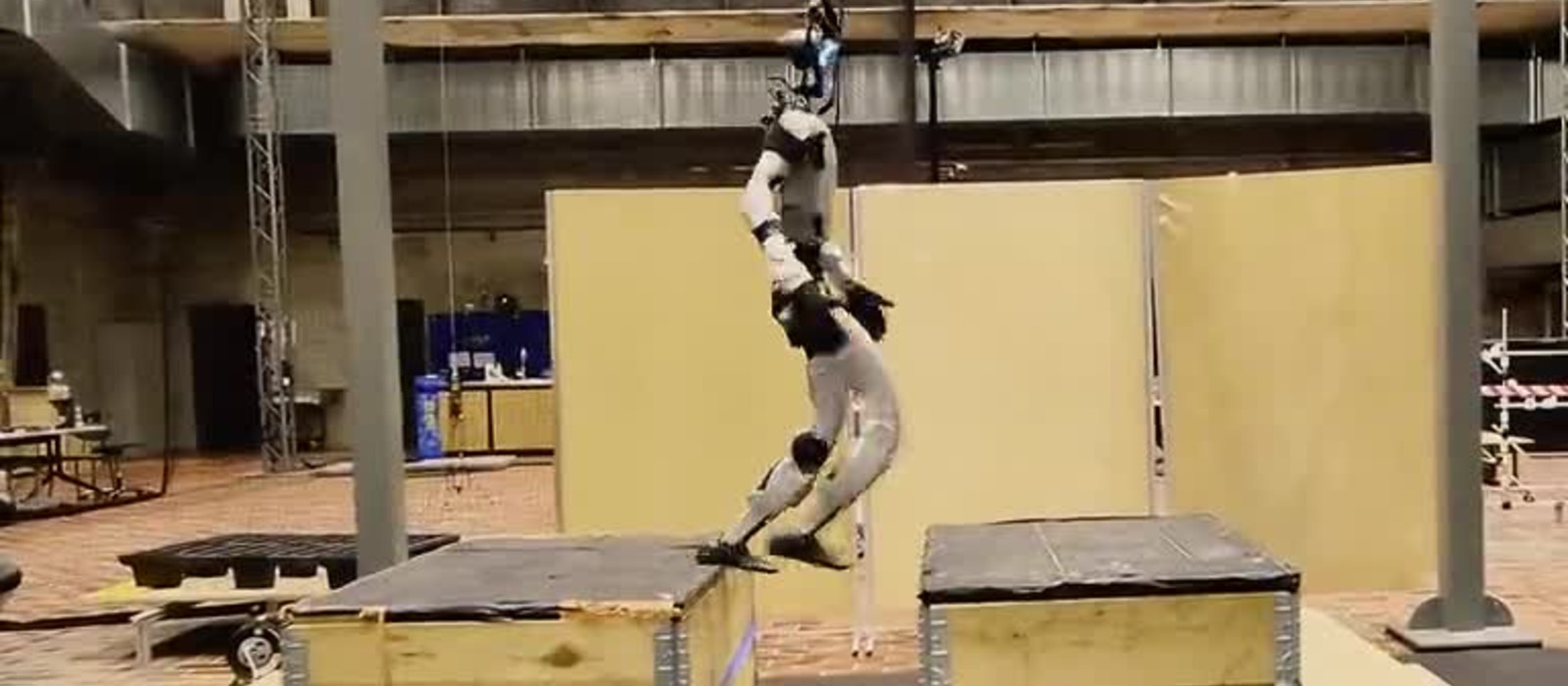
Watch Your Step cuts what Unitree G1 needs to see before it steps
A foothold predictor reduces the terrain input from 693 heights to 102 values and reaches the training curriculum roughly three times sooner. Real G1 videos show transfer, not measured reliability.
Reader discussion
No comments yet. Add the first thoughtful contribution.
Join the discussion