SWAP gives Unitree G1 more than one way around an obstacle
A diffusion planner lets G1 choose among ducking, sidestepping and turning motions at run time. The physical evidence is promising, but it amounts to five trials per scenario.
Review basis: Analysis based on public information
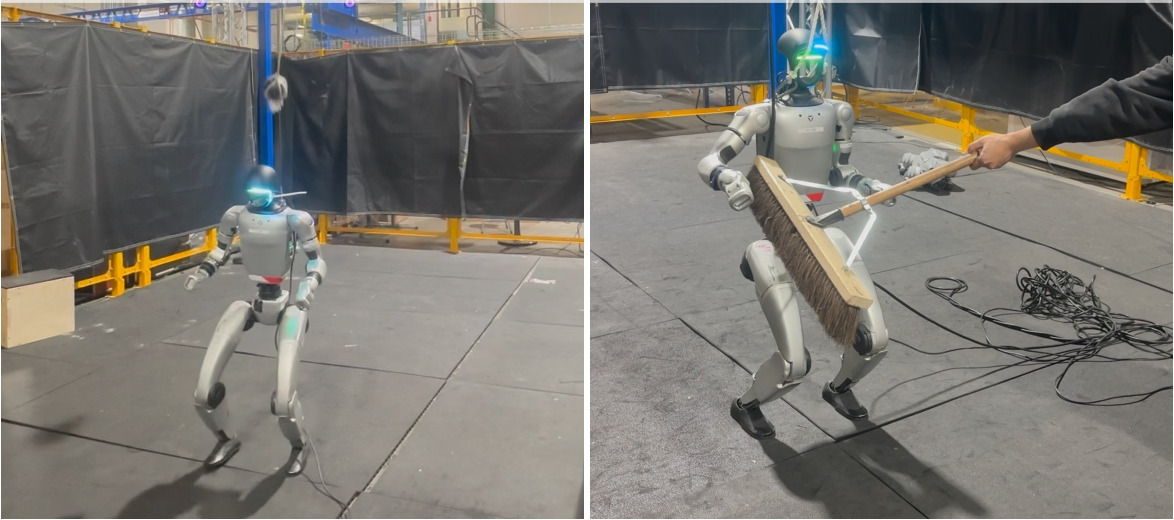
A humanoid does not fit through a crowded space by moving its feet alone. Its shoulders, arms, torso and head can all collide even when its footpath is clear. A new research system called SWAP treats that problem as whole-body motion planning and demonstrates the result on a physical Unitree G1.
The work is useful because it moves beyond a single scripted dodge. The same static-obstacle policy can select different motions at run time — ducking, sidestepping, turning or changing arm posture — without retraining for each preference. But the evidence is still an early laboratory result: five physical trials per scenario, motion-capture support for localisation, and test obstacles drawn from a narrow family.
The planner proposes; the controller keeps G1 upright
SWAP separates obstacle avoidance from balance. A high-level diffusion policy reads LiDAR-derived obstacle information and proposes several short whole-body trajectories. A lower-level reinforcement-learning controller tracks the selected trajectory at 50 Hz while maintaining locomotion and balance.
At each planning step, the system samples 32 candidate trajectories and scores them against a chosen objective. That objective can favour a target speed, heading, body height or arm position. A learned collision-aware score can instead favour candidates expected to avoid contact. The policy itself is not retrained when the operator changes that preference; the change happens by selecting a different proposal at run time.
That distinction matters. SWAP is not a language-conditioned general robot brain and it does not decide where a useful task should happen. It is a specialised motion layer that can sit beneath a navigation system and turn a route into a feasible whole-body passage.
The training data also avoids physical teleoperation. Researchers first ran randomised commands through the low-level controller in simulation, measured the volume occupied by the executed robot motion, then placed synthetic obstacles outside that swept volume. After augmentation and filtering, the paper reports 78,900 perception–trajectory pairs from 2,356 base rollouts. The method therefore learns from motions the simulated controller could actually execute rather than from ideal reference poses alone.
The 88.3% result is simulated
Across five simulated tasks, the full system averaged an 88.3% success rate. The tasks were sideways passage through a narrow gap, ducking under a bar, lifting one hand past an obstacle, avoiding a fast swinging object and responding to a slower moving obstacle.
That number should not be transferred to the physical G1. It is an average from simulation, reported across three seeds. The researchers define success as reaching the goal without falling or colliding. An end-to-end diffusion baseline averaged 17.4%, while the same hierarchical system without test-time steering averaged 72.4%. This supports the value of separating high-level proposals from balance control and then choosing among proposals, within the authors’ test setup.
The physical evaluation is much smaller. On a G1 fitted with a Livox Mid-360 LiDAR and an onboard Jetson Orin, SWAP succeeded in four of five sideways trials, three of five ducking trials, four of five hand-lifting trials, three of five fast-dynamic trials and four of five slow-dynamic trials.
Those 25 researcher-run trials show real transfer, not a commercial safety level. Failures were attributed mainly to LiDAR occlusion during extreme poses and mismatch between simulated and physical tracking during agile movement. No independent team has yet reproduced the result.
Dynamic avoidance still receives external state
For static obstacles, the paper says obstacle perception comes entirely from the G1’s LiDAR module. Motion capture is still used to localise the robot. In the dynamic-obstacle experiments, motion capture also specifies the moving obstacle’s state because the 10 Hz LiDAR stream is not fast enough for the required tracking.
Dynamic tasks also use a separately trained high-level policy. That limits the strongest interpretation of “one policy”: a single high-level model covers the reported static tasks and accepts different test-time objectives, but it does not cover the full static-and-dynamic set unchanged.
The system is autonomous in the narrow control sense used in the experiment: a person is not teleoperating each joint or choosing every dodge. It is not autonomous navigation through an unfamiliar workplace, and the paper does not test people moving unpredictably around the robot.
What this adds — and what it does not
The interesting contribution is the interface between learned motion diversity and a practical control loop. Diffusion generates more than one physically plausible way through a gap; a fast scorer chooses the version that best fits the current objective; a dedicated controller keeps the robot balanced. That is a more flexible route than training a new end-to-end policy for every posture or passage.
The generalisation claim remains deliberately narrow. Held-out simulated layouts changed wall positions, angles and gap sizes, but the nearest training layouts still overlapped them by 84–90%. The authors explicitly do not claim generalisation to arbitrary furniture-like scenes. Their project page also lists code and videos as “coming soon”, so the result cannot yet be reproduced from a public deployment stack.
For Australian laboratories and developers working around equipment, shelving or temporary barriers, the paper offers a credible architecture to investigate. It does not yet justify putting a G1 into a shared workplace without external safeguards, independent testing and a much broader set of people, objects, lighting conditions and failure cases.
PHASE reviewed the paper, its submission history and the official project page on 21 October 2026. This is an analysis of public research, not a hands-on test.
Sources & analysis
Primary source
SWAP: Test-Time Steerable Humanoid Whole-Body Collision Avoidance arXiv · Published 2026-10-19 · Retrieved 20 October 2026
Primary source
SWAP arXiv record and submission history arXiv · Published 2026-10-19 · Retrieved 20 October 2026
Primary source
SWAP official project page SWAP research team · Published 2026-10-19 · Retrieved 20 October 2026
This is an independent, unofficial publication and is not affiliated with Unitree Robotics.
Related reading
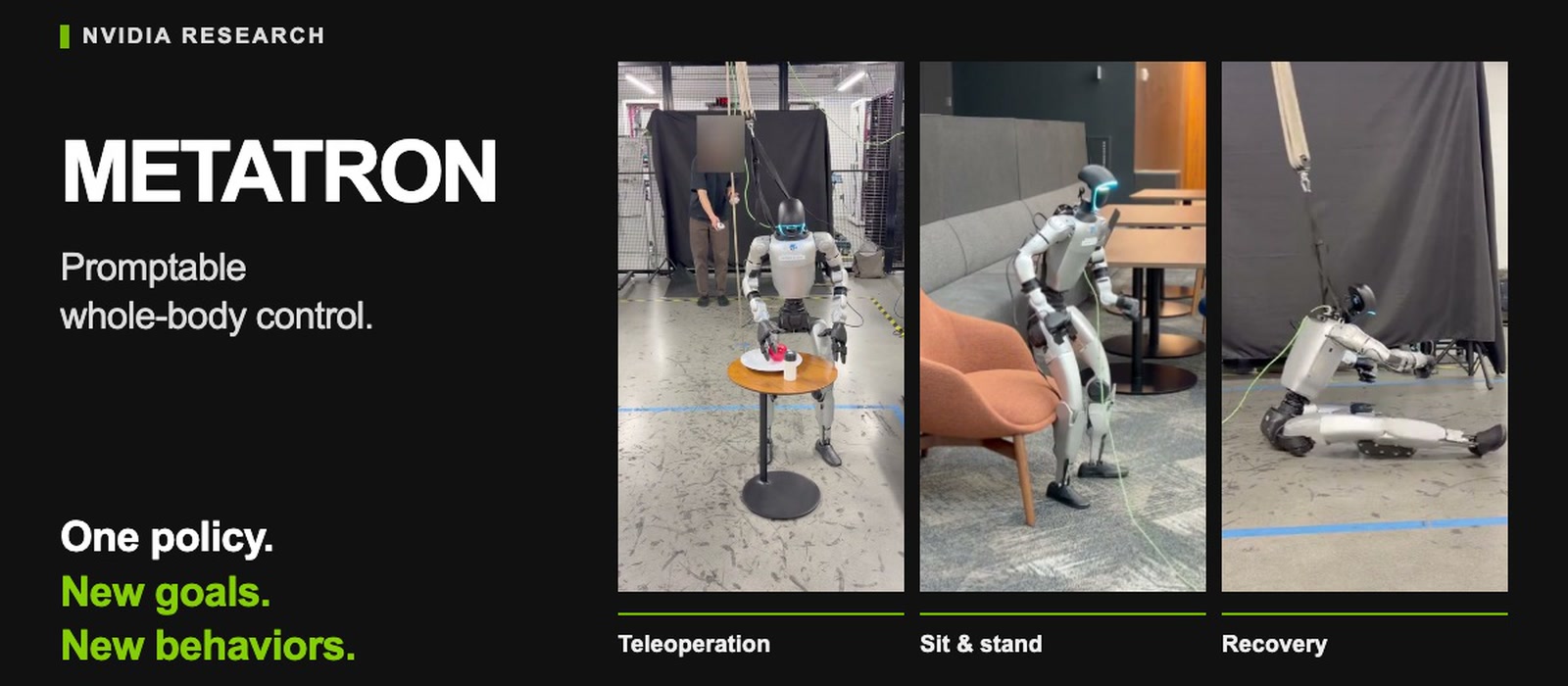
Metatron gives Unitree G1 one frozen controller. The benchmarks are still simulated.
NVIDIA’s policy handles steering, reaching, recovery, teleoperated pickup and sitting through changing goal prompts. Its 83% reaching result and push tests are MuJoCo results, while hardware evidence remains qualitative.
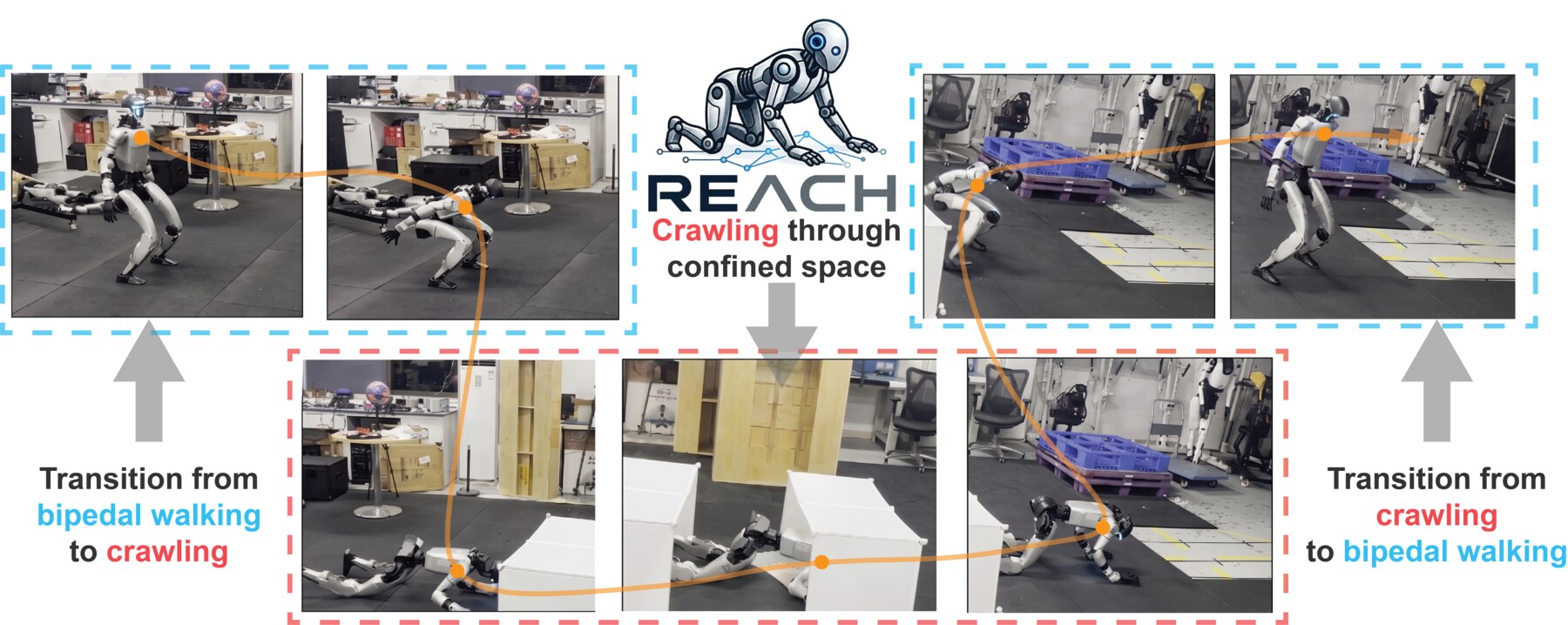
REACH gets Unitree G1 under a 40 cm clearance. The reliability result is narrower.
The system combines LiDAR planning, variable-height walking and crawling. Its 48/50 real-robot transition result is measured; the full confined-space runs are still demonstrations.
Watch Your Step cuts what Unitree G1 needs to see before it steps
A foothold predictor reduces the terrain input from 693 heights to 102 values and reaches the training curriculum roughly three times sooner. Real G1 videos show transfer, not measured reliability.
Reader discussion
No comments yet. Add the first thoughtful contribution.
Join the discussion