Whole-Body Dexterity gives Unitree G1 more ways to hold a load
A learned controller helps G1 keep a ball or box supported as it changes grip. The tests are human-guided, and the full shelf-to-table sequence succeeds in seven of ten trials.
Review basis: Analysis based on public information
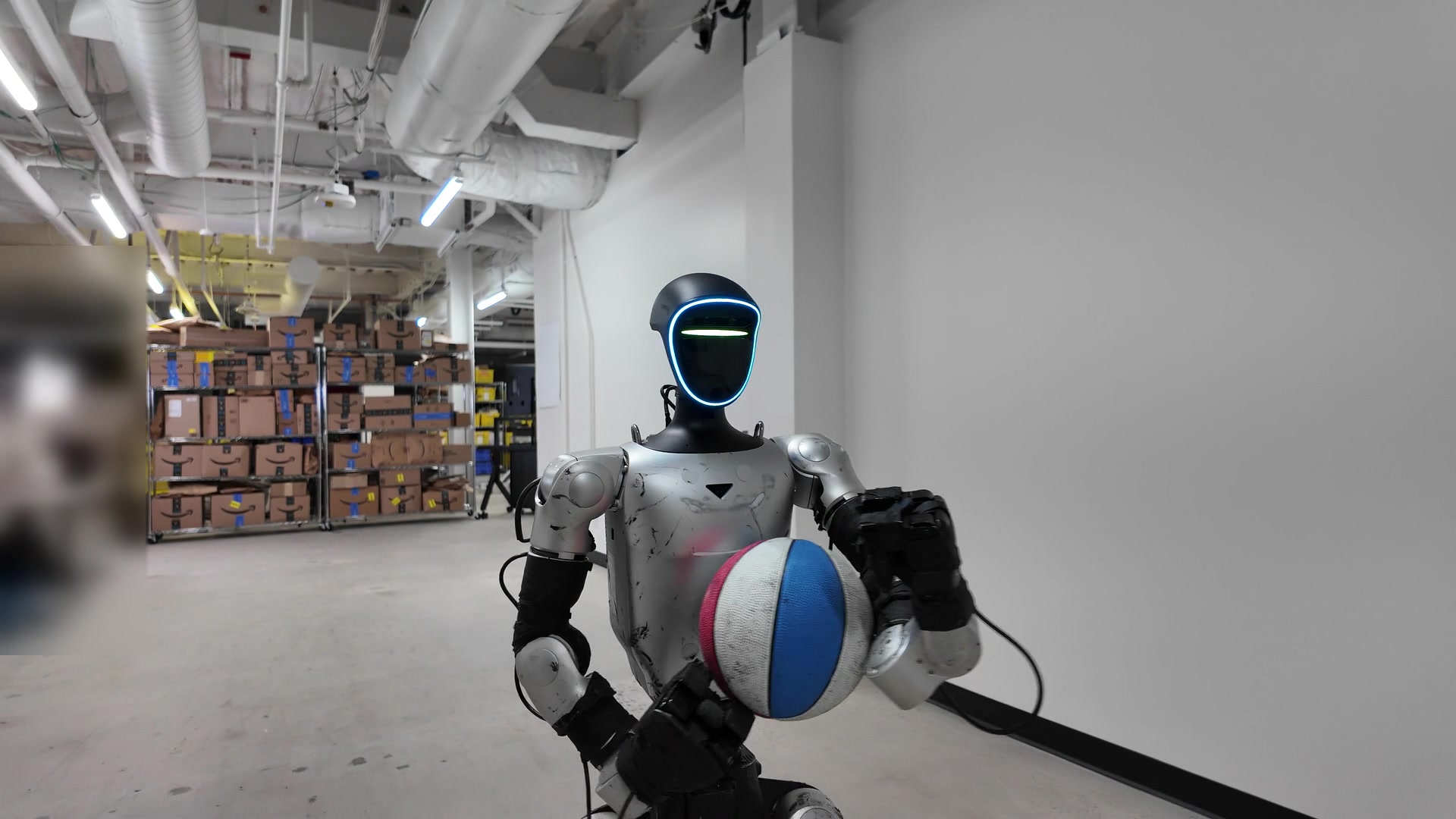
Unitree G1 does not need to hold everything between its hands. A new Whole-Body Dexterity controller lets it brace a basketball against its torso, shift an object towards a shoulder, or tuck a box under one arm while changing the supporting contacts.
The work comes from researchers affiliated with Amazon, the University of California, San Diego and the University of Michigan. Their preprint, submitted on 15 October 2026, reports a substantial improvement over two tested control baselines on a physical G1.
The important qualification is built into the experiment: a human still supplies the movement intent. This is a learned aid for contact-rich manipulation, not an autonomous robot deciding what to collect and where to deliver it.
A grip can extend beyond the hands
People routinely hold a box against their chest or use a forearm to keep it supported while moving the other arm. For a robot, those transitions are difficult. Copying a person’s arm positions does not guarantee that an object remains pinned, rather than slipping out as the supporting contact changes.
Whole-Body Dexterity, or WBD, treats the arms and torso as useful contact surfaces. It first generates stable grasp configurations in simulation, then trains object-specific reinforcement-learning controllers to move between them. Their movements are distilled into a shared controller that refines coarse commands.
The training distinguishes left-arm, right-arm and both-arm holds. A handoff between sides passes through a both-arm hold, giving the object support while the robot changes its configuration. Sliding and rolling against the torso become part of the movement rather than errors to eliminate.
That is a useful shift in what dexterity means. A humanoid’s value need not depend entirely on increasingly elaborate fingers; its existing body can provide additional ways to hold and reposition an object.
The deployed controller uses the robot’s own motion history together with a description of object geometry. It does not require the object’s exact pose as a privileged input at every step. But the geometry is not discovered automatically: for physical objects, the researchers calculate that description from measured dimensions.
What the 90% result actually counts
The physical evaluation uses a size 3 basketball and a 15 cm cardboard cube. For each object, G1 attempts a shoulder-contact round trip and an underarm-stow round trip. Each starts and finishes with a stable two-arm hold in front of the body.
Those four object-task combinations account for 40 trials. WBD completes 38. A further ten trials test a longer sequence: pick a box from a shelf, stow it under one arm, carry it while walking, bring it back into a two-arm grasp and place it on a table. Seven finish the sequence.
Together, that produces the paper’s 45/50, or 90%, result. Direct General Motion Retargeting completes 9/50, while the tested SONIC configuration completes 2/50. These are researcher-reported results under the stated setup, not PHASE’s independent tests.
The distinction between the pooled result and the longer task matters. WBD reaches the carrying and un-stowing stages in nine of ten shelf trials, but only seven finish placement. Describing it as a robot that reliably completes 90% of shelf-to-table jobs would overstate the evidence.
The comparison also concerns specific implementations. WBD and direct retargeting share GMR upper-body motion targets and an Adaptive Motion Optimization lower-body controller. SONIC is tested using its public checkpoint in a three-point mode driven by head and wrist poses. The result does not establish that WBD is superior to every possible use or adaptation of either baseline.
The operator still chooses the movement
All physical trials use one skilled operator with more than eight hours of practice on these tasks. An Xsens motion-capture suit records the person’s movement; WBD adjusts the resulting arm commands to preserve support as the arms and torso reconfigure.
During the shelf sequence, the operator also changes the strength of command guidance between repositioning and picking or placing. A separate controller handles the lower body and balance. Several arm links carry grip tape to improve friction, according to the project page.
These details are part of the system that achieved the result. They should not disappear behind a claim that the G1 learned to perform the task by itself.
The underarm hold is not an unconditional promise of a free second hand, either. The shelf-task protocol allows that arm to stabilise the box while walking. What has been shown is more flexible support through a sequence of movements, not hands-free transport in every phase.
A useful control skill, not a logistics deployment
For Australian research teams and integrators, WBD suggests a practical line of investigation: can a learned contact controller make human-guided handling less fragile without requiring an operator to manage every supporting contact precisely?
That question is different from whether a humanoid can replace a warehouse worker. The study does not establish industrial payload capacity, throughput against human labour, performance across a warehouse inventory, or sustained operation without an expert nearby. Two physical object types and a small number of trials cannot settle those issues.
It also complements rather than duplicates PHASE’s earlier Workhorse and λ0 coverage. Those projects examine routes from human experience to whole-body behaviour. WBD concentrates on keeping an object supported while the robot changes how its body holds it.
The next useful tests are multiple operators, unfamiliar object shapes and materials, and repeated complete handling sequences. Until then, the advance is specific but meaningful: G1 can use more of its body to make a human-guided grip work.
Sources checked on 20 October 2026 (Australia/Melbourne). PHASE has not physically tested the system.
Sources & analysis
Primary source
Whole-Body Dexterity - technical paper, v1 Whole-Body Dexterity research team · Published 2026-10-15 · Retrieved 19 October 2026
Primary source
Whole-Body Dexterity - official project, demonstrations and real-world results Whole-Body Dexterity research team · Retrieved 19 October 2026
Primary source
Whole-Body Dexterity - arXiv submission history arXiv · Published 2026-10-15 · Retrieved 19 October 2026
This is an independent, unofficial publication and is not affiliated with Unitree Robotics.
Related reading
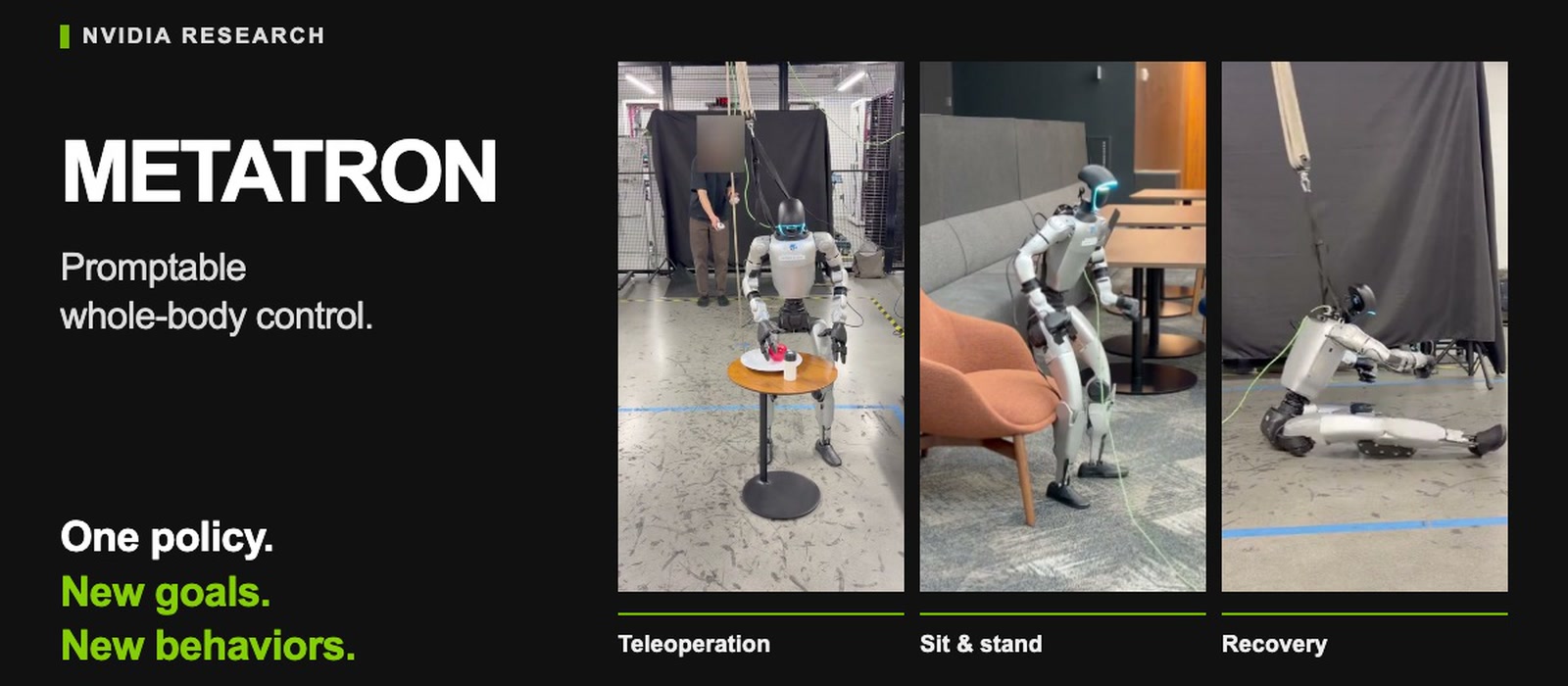
Metatron gives Unitree G1 one frozen controller. The benchmarks are still simulated.
NVIDIA’s policy handles steering, reaching, recovery, teleoperated pickup and sitting through changing goal prompts. Its 83% reaching result and push tests are MuJoCo results, while hardware evidence remains qualitative.
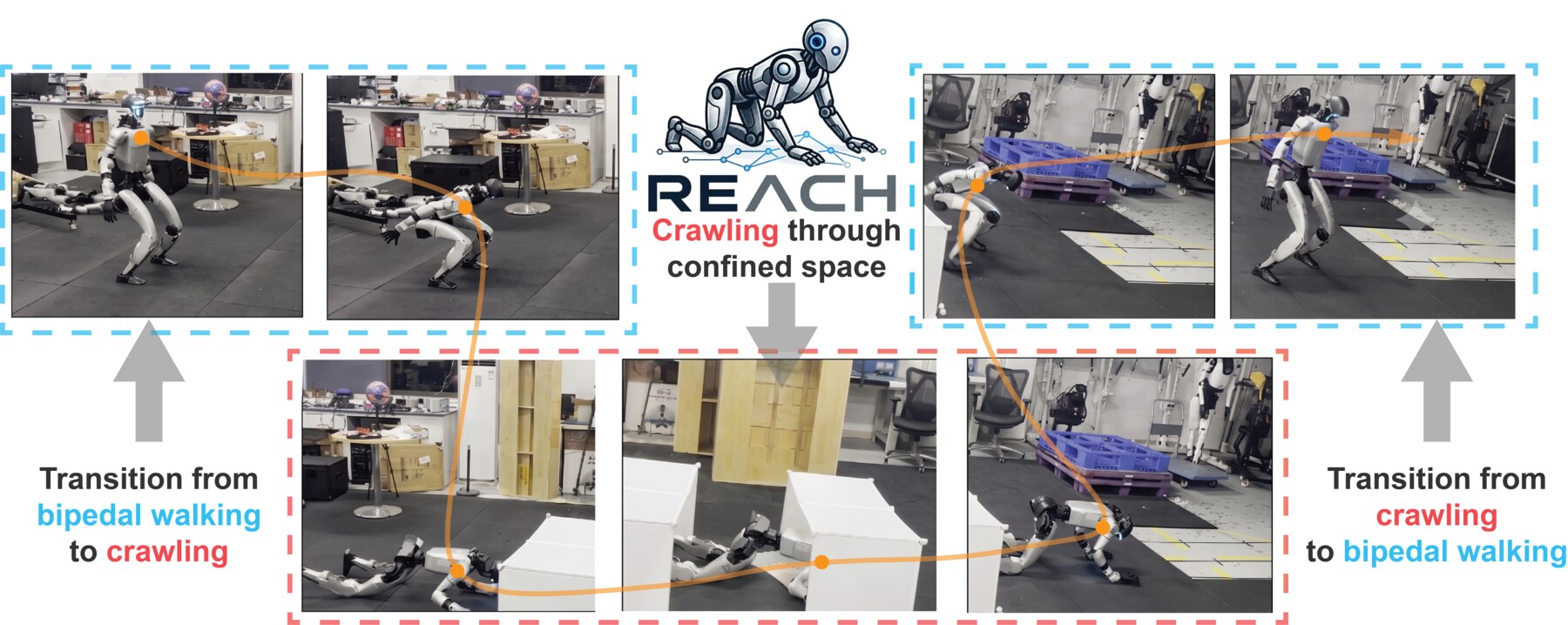
REACH gets Unitree G1 under a 40 cm clearance. The reliability result is narrower.
The system combines LiDAR planning, variable-height walking and crawling. Its 48/50 real-robot transition result is measured; the full confined-space runs are still demonstrations.
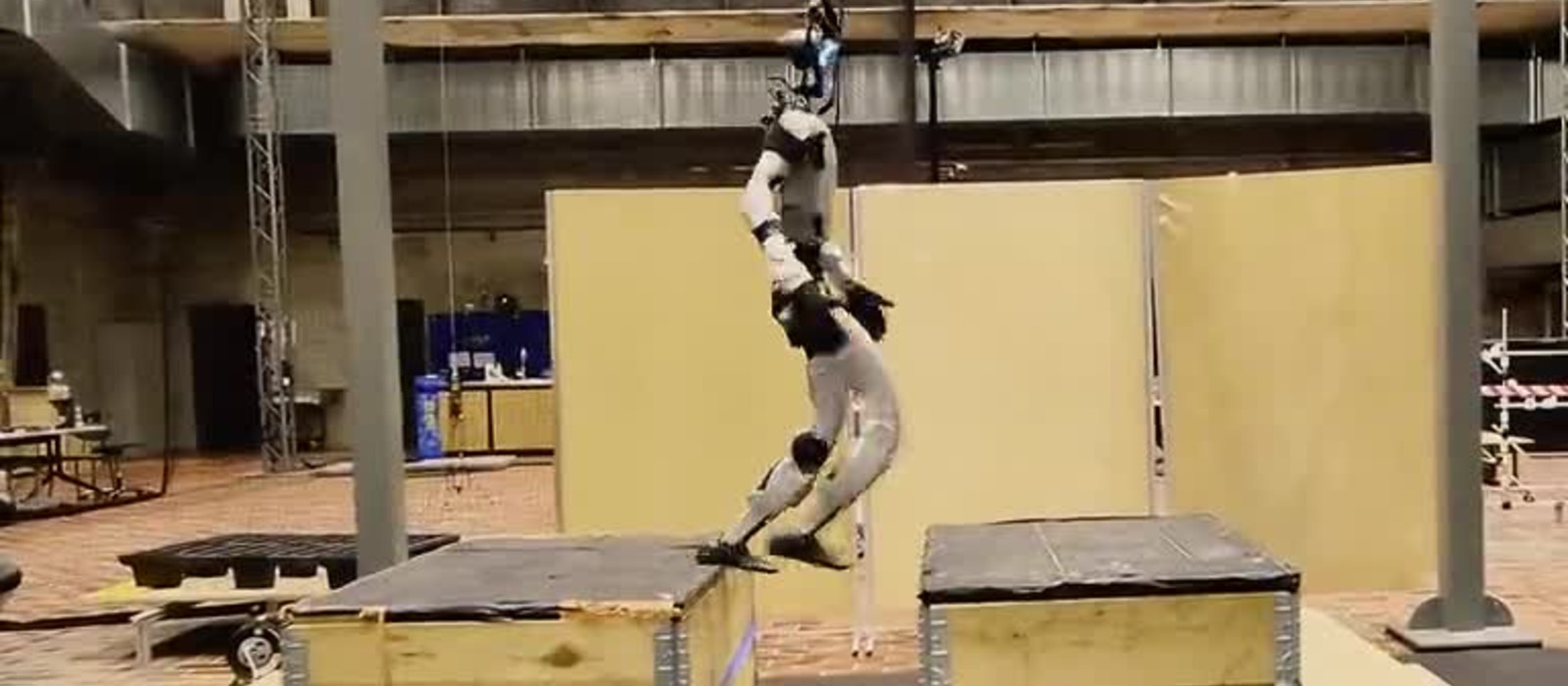
Watch Your Step cuts what Unitree G1 needs to see before it steps
A foothold predictor reduces the terrain input from 693 heights to 102 values and reaches the training curriculum roughly three times sooner. Real G1 videos show transfer, not measured reliability.
Reader discussion
No comments yet. Add the first thoughtful contribution.
Join the discussion