Workhorse gives Unitree G1 a different route to whole-body autonomy
Instead of asking one policy to control every joint, Workhorse separates visual planning from whole-body tracking and connects them through five human-scale poses. The result is dynamic autonomy on a real G1—but not yet a general or open system.
Review basis: Analysis based on public information
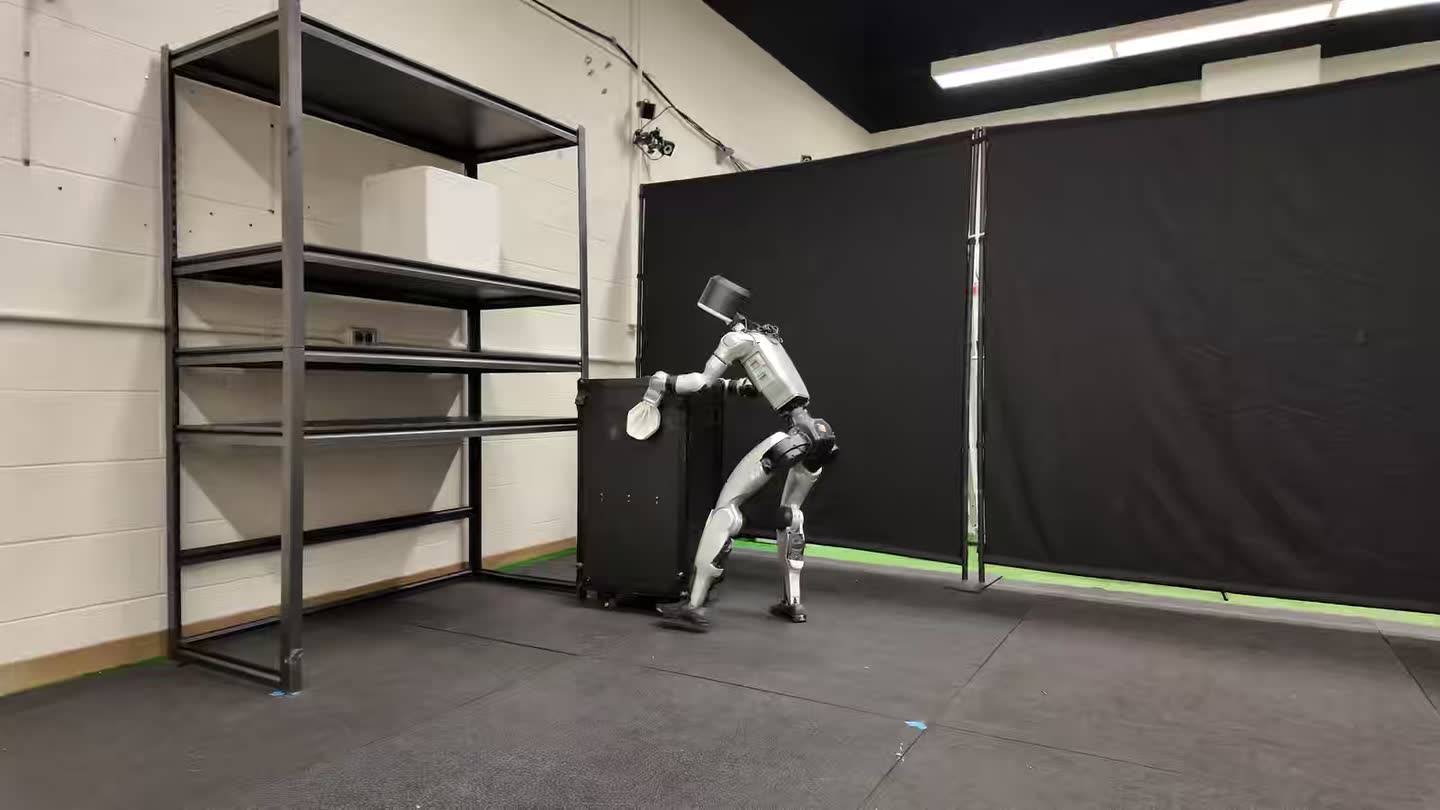
The most interesting part of Workhorse is not that a Unitree G1 can kick a box. It is how the system gets from a human demonstration to that kick without teleoperating the robot or first converting the motion into a G1-specific joint trajectory.
Researchers at UC Berkeley trained a visual planner to predict the poses of five body links—the torso, both wrists and both feet. A separate reinforcement-learning controller tracks those targets with the robot’s full body. On a real G1, the resulting system sorts boxes with its hands and a foot, catches a thrown box, and pushes, topples and climbs onto a 14 kg suitcase to retrieve an object from a high shelf. At deployment, it uses an egocentric RGB camera and proprioception rather than external motion capture or a human operator. [S1] [S2]
That is a different route to whole-body autonomy from an end-to-end policy that maps camera images directly to every robot joint. Workhorse inserts a compact, human-readable interface between perception and control. The planner decides where five important links should go; the tracker solves how the G1 should move its joints, balance and make contact to get them there.
Five poses carry the plan
The visual planner reads four recent camera images and about one second of five-link motion history. At 5 Hz, it predicts a 1.16-second chunk of future targets. The whole-body tracker runs at 50 Hz and continually reads the next 0.2 seconds of that plan before producing joint setpoints. [S1] [S2]
The choice of interface is the central idea. It contains task-space poses, not G1 joint angles. The same recorded human motion can therefore train the planner and the tracker without an offline retargeting stage that first forces the demonstration into one robot’s anatomy. To adapt the approach to a different humanoid, the researchers change five link mounts and the robot model, then retrain both policies from the same human demonstrations. In simulation, a Unitree H2 trained this way completed box sorting in 83% of episodes, compared with 77% for the G1. The difference was within the uncertainty reported by the authors, and the H2 result has not yet been transferred to a real robot. [S1]
Workhorse does not eliminate embodiment differences. The paper says the human motion is not scaled, so a robot with proportions closer to the demonstrator may reach the targets more easily. It moves the robot-specific work into the tracker and the five measured mounts rather than pretending that bodies are interchangeable.
Human data without occupying the robot
The demonstrations were collected with five HTC Vive trackers—one on the chest camera, one on each hand and one on each shoe—inside a Lighthouse-tracked room. A chest-mounted DJI action camera recorded the demonstrator’s view. One person supplied 2.2 hours of box-sorting data, 1.2 hours for the suitcase sequence and 13 minutes for catching. [S1] [S2]
This matters because robot time is expensive. A robot-free recording rig lets a person demonstrate dynamic movements without a G1, a safety operator or a teleoperation interface slowing the motion. Feet can become active tools rather than merely locomotion endpoints: the human can kick, brace and climb naturally, then the tracker learns how the robot can reproduce the five-link plan.
There is still substantial processing. The recorded images show a person, while the G1’s camera sees the robot’s own body. The researchers segment the demonstrator out of each image, inpaint the gap and render the robot into the frame. They also synchronise the camera and tracker streams and use a live inverse-kinematics preview during recording to flag poses the robot cannot reach. “Robot-free” describes data capture, not a frictionless path from raw video to deployment. [S1]
The two policies are trained to survive each other
Separating planning and control creates a new failure mode: neither module behaves exactly as the other expects. A tracker misses targets, state estimates drift and a fresh plan can jump when it arrives. Those errors compound in closed loop.
Workhorse addresses that interface explicitly. Tracker training adds drifting and periodically resetting commands. Planner training adds drift to the motion history and warps the images to match the displaced camera view. Each policy is therefore trained on approximations of the errors the other will produce at deployment. [S1] [S2]
The simulation ablations support the importance of that design. In a reconstructed version of the demonstration room, the full G1 system completed box sorting in 77% of 100 episodes without pushes and 64% with repeated 40 N·s pushes. Removing planner augmentation reduced those results to 20% and 0%. Removing tracker command augmentation barely changed the no-push result—76%—but reduced pushed success to 52%. [S1]
Those are simulation results, not measured real-world reliability. On the real G1, the paper shows capability demonstrations and recovery when a person pushes the robot or removes a box, but it does not report a real-robot success rate. The distinction is important: a convincing video of recovery is evidence that the behaviour exists, not a frequency estimate for how often it works.
A route to autonomy, not a general autonomous worker
Workhorse is autonomous during the reported G1 demonstrations, but its autonomy is narrow. Each of the three tasks has its own visual planner and its own whole-body tracker. All data came from one demonstrator in one room, and testing stayed in that room or its reconstructed simulation. The planner runs on an external laptop, the five-link interface omits fingers and the head, and the authors say the code has not yet been released. [S1] [S2]
That prevents the current project from supporting broader claims about a reusable household or industrial robot policy. It has not shown one model switching between tasks, following language instructions, adapting to a new building or operating through a work shift. Its cross-embodiment result is promising but simulation-only.
The stronger conclusion is architectural. Whole-body autonomy may not require one model to learn perception, task planning, balance and every joint command as a single inseparable policy. Workhorse shows a credible alternative: learn a compact plan in human-scale coordinates, let a specialised whole-body controller realise it, and deliberately train both sides for the errors at their boundary.
The next evidence should be practical and reproducible: released code, real-robot trial counts, cross-room testing, a physical H2 deployment and a single policy covering more than one task. Until then, Workhorse is best read as a well-designed research path—not a finished autonomy stack for G1 owners. Its contribution is to make the route between human intent and robot motion simpler enough to inspect, transfer and stress-test.
Sources & analysis
Primary source
Workhorse: Learning Robust Whole-Body Humanoid Loco-Manipulation from Human Data UC Berkeley · Published 2026-10-06 · Retrieved 10 October 2026
Primary source
Workhorse — project page and demonstrations UC Berkeley Hybrid Robotics · Published 2026-10-06 · Retrieved 10 October 2026
Primary source
Workhorse: Learning Robust Whole-Body Humanoid Loco-Manipulation from Human Data — video Hybrid Robotics · Published 2026-10-06 · Retrieved 10 October 2026
This is an independent, unofficial publication and is not affiliated with Unitree Robotics.
Related reading
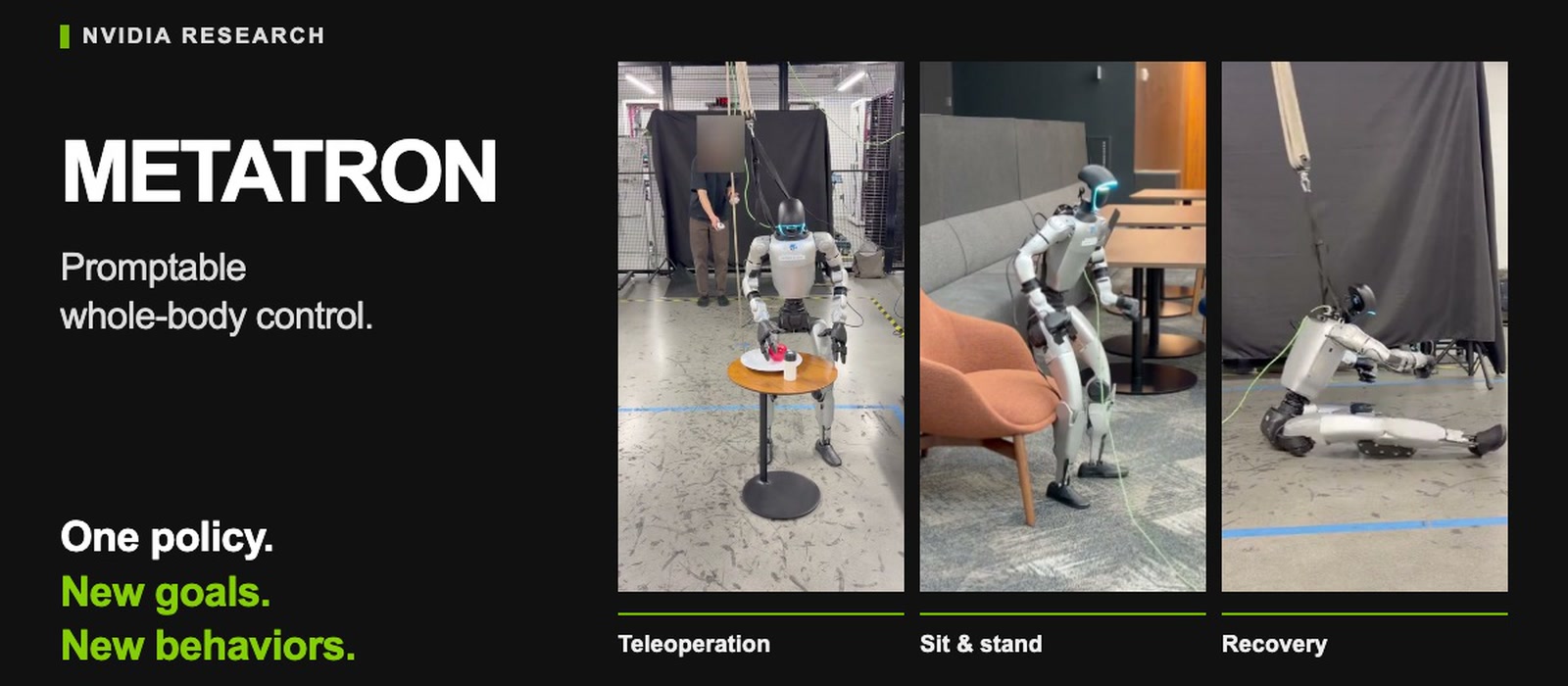
Metatron gives Unitree G1 one frozen controller. The benchmarks are still simulated.
NVIDIA’s policy handles steering, reaching, recovery, teleoperated pickup and sitting through changing goal prompts. Its 83% reaching result and push tests are MuJoCo results, while hardware evidence remains qualitative.
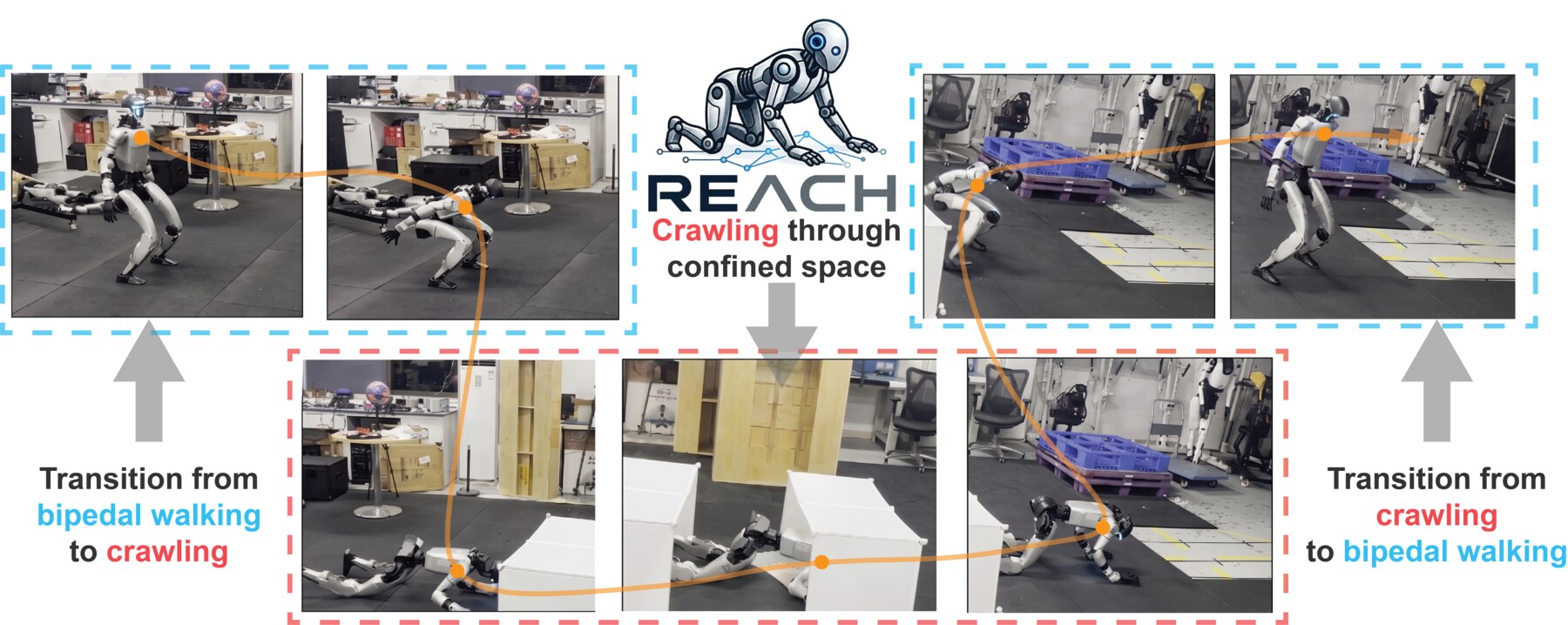
REACH gets Unitree G1 under a 40 cm clearance. The reliability result is narrower.
The system combines LiDAR planning, variable-height walking and crawling. Its 48/50 real-robot transition result is measured; the full confined-space runs are still demonstrations.
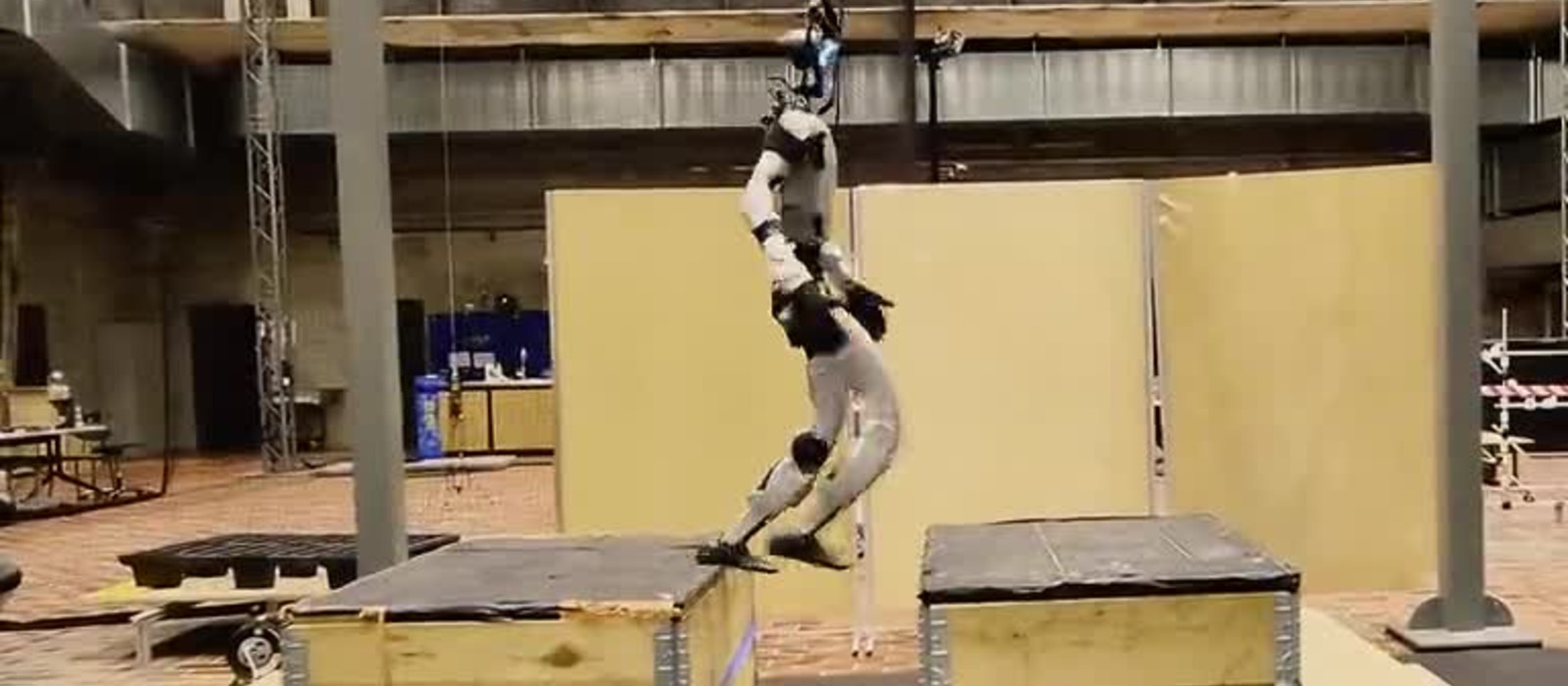
Watch Your Step cuts what Unitree G1 needs to see before it steps
A foothold predictor reduces the terrain input from 693 heights to 102 values and reaches the training curriculum roughly three times sooner. Real G1 videos show transfer, not measured reliability.
Reader discussion
No comments yet. Add the first thoughtful contribution.
Join the discussion